
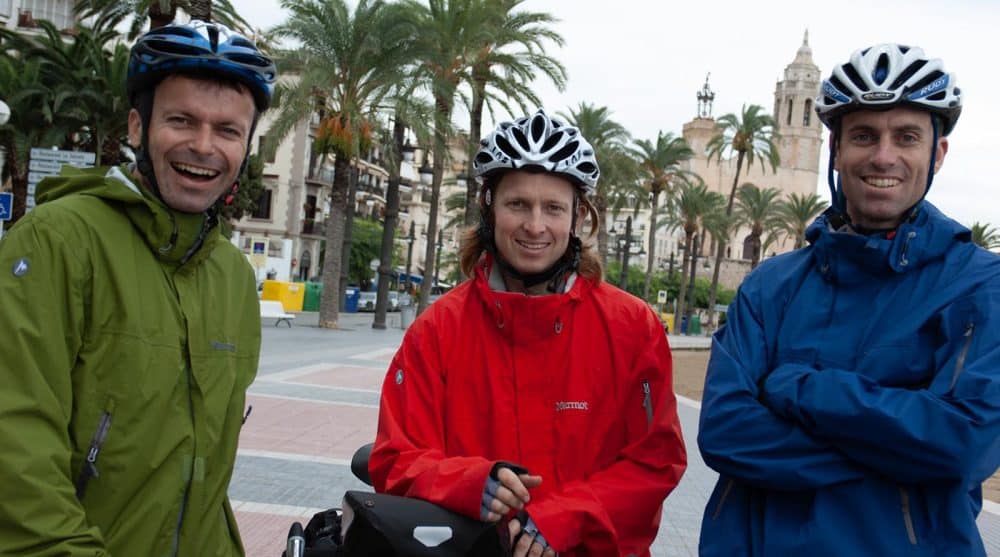
The first historical bike tour, the kind that follows a real historical figure’s route day by day, began with On Hannibal’s Trail, a six-part BBC documentary series. In September 2009 my brothers Danny and Ben and I rode Hannibal’s route by bicycle for ten weeks. We rode roughly 3,500 km (2,200 miles) from Cartagena in Spain, over the Pyrenees, across the Rhône, over the Alps and down through Italy, then crossed to Tunisia. BBC Four broadcast the series from 19 July 2010, and it later went out on BBC Two, National Geographic and Viasat in more than 70 countries. The Hannibal bike tour, and the whole idea of a cycling holiday built around one historical journey, grew out of that series. I’m Sam Wood. It was my idea, and this is how it happened.
Why Hannibal?
Ever looked at a map of Hannibal’s march and wondered what it would actually feel like to do it?
In 218 BC Hannibal Barca, the Carthaginian general, left New Carthage (modern Cartagena) with an army of tens of thousands, cavalry and a few dozen war elephants. He marched up the coast of Spain, over the Pyrenees, across southern Gaul and the Rhône, and then, late in the season, over the Alps into Italy. What followed was a string of the most famous victories in military history: Trebia, Lake Trasimene and then Cannae, where a Roman army was all but wiped out in a single afternoon. Hannibal stayed in Italy for fifteen years and never took Rome. He was recalled to Africa and finally beaten by Scipio at Zama in 202 BC.
That is a journey, not just a war. It has a start, a route, mountain passes, river crossings, a destination and an ending. It unfolds across Spain, France, Italy and Tunisia, through some of the best cycling country on earth. I had spent ten years as a field archaeologist, at Pompeii, in Cyprus, Ukraine and Israel, and later at the British Museum. To me it seemed obvious that the best way to understand Hannibal’s march was to travel it at something close to human pace. Not in a car. Not in a studio. On a bike.
From a hare-brained plan to a BBC commission
I started researching the idea in 2006 and talked my older brothers into it. Danny was a journalist and Ben was in IT, and none of us was a professional cyclist. In 2006 the BBC showed interest. In 2009 they commissioned the series.
It was my idea, and that is on the record. Cycling UK’s magazine put it plainly in 2010: “Youngest brother Sam had the idea of following Hannibal’s Italy invasion route on bicycles.” Cycling UK, 2010 (PDF)
My brothers said the same thing live on BBC Breakfast, on the same sofa as David Cameron and Earth, Wind & Fire! Yes a very unusual combination, the Prime Minister of UK, a 70’s disco band and us!!
By August 2009 our kitchen table had become an expedition office. We had Ortlieb panniers, sleeping mats, a medical kit, tents and maps everywhere. We logged training rides everywhere from Richmond Park, London (Ben) to Madrid, Spain (Danny) and Newcastle, Australia (me). We also had lovely touring bikes collected from Leyland in the Midlands. We logged all of it as we went, on the blog we kept at the time, and that original 2009 ride diary is still online, with every post carrying its original date.
Ten weeks on Hannibal’s trail
We started filming on the harbour at Cartagena on 6 September 2009. The night before, around 40 members of the Cartagena Carthaginian and Roman society met us at dinner in full armour. We interviewed “Hannibal”, “Hasdrubal” and “Mago”, which is not a sentence many documentary makers get to write.
Then we rode. We went north through Saguntum, where Hannibal’s siege lit the fuse on the Second Punic War, then through Valencia, the rice paddies of the Ebro and Catalonia, and over the Pyrenees into France. We raced up Mont Ventoux on camera, crossed the Rhône where Hannibal ferried his elephants on rafts, and then climbed into the Alps. We went looking for the pass itself, on the long march to the Col du Clapier and the longer march to the Col de la Traversette, before dropping into Italy.
Italy gave us the battlefields: the Trebia, Lake Trasimene and Cannae. Then we crossed to Tunisia, to Zama, where the story ends, and to the Roman and Carthaginian ruins at Dougga. The last diary entry, “End of an Epic”, went up on 15 December 2009. We also wrote dispatches for the BBC History Magazine blog as we went, stage by stage: Sagunto, the Rhône, the Alps, Trasimene, Cannae and Zama.
Filming and cycling are not natural companions. Every shot means riding the same stretch of road two or three times, and ten weeks of it was a real physical and mental test. It was also the best way I have ever found to understand ancient history. You feel the gradient of a pass in your legs. You work out for yourself why an army would camp in that valley and not the next one. You meet the people who still live on the route. That is the whole idea of a historical bike tour, and it started here.
On air: BBC Four, BBC Two, National Geographic and 70+ countries
On Hannibal’s Trail premiered on BBC Four on Monday 19 July 2010 at 8:30pm. It ran for six episodes of about half an hour each:
- Hitting the Road
- Barca! Barca! Barca!
- Crossing the Rhone
- Over the Alps
- Hannibal the Great
- Hannibal at the Gates
The documentary is still on the BBC website here
The UK press picked it up straight away. The Sunday Times called it “Tour de Warrior”, The Guardian said “Fun, inspiring and educational, like a history lesson from your mates down at the pub” The Observer “Well informed and surprisingly engaging”, the Telegraph wrote that “The idea…is a good one, the result is enjoyable too.” BBC Two repeated the series in early 2012. National Geographic Channel bought it in September 2012 and Viasat followed in 2013, taking it to audiences in more than 70 countries. Watch the episodes and read more about the documentary.
We also set up the Jama Fund to help refurbish a school in the Tunisian village near the battlefield of Zama. We delivered the first donation in 2011, and the school refurbishment was completed in 2014.
From TV series to the first Hannibal bike tour
When the series was repeated on the BBC in 2011, we asked our audience where we should ride next. More and more of the people who had watched Hannibal’s trail wanted to ride it themselves.
So in 2012 I led the first Hannibal bike tour. It was the first cycling tour designed to follow Hannibal’s route from Spain over the Alps to Rome, built on the research, the roads and the contacts from the BBC ride. Today Bike Odyssey runs that route as the Hannibal Odyssey. The full timeline is here. In 2021 the book Ride: Cycle the World named it one of the 100 best rides in the world, and put the origin on record: “The Hannibal Ride is the brainchild of Sam Wood”.
That same idea became the blueprint for everything Bike Odyssey has done since. Each tour follows a real historical figure or event. Each route is ridden, researched and tested for around two years before the first guest turns a pedal, and each is guided by people who know the history as well as the roads. Here’s what actually makes a cycling tour historically themed.
Who started historical bike touring? The paper trail
Historical bike touring has become a genre of its own, and other companies now run Hannibal tours too. That is good for cycling and good for history. But the origin is not in doubt, and it is documented, dated and public:
- 2006: Working at the British Museum, I begin researching a bicycle journey along Hannibal’s route.
- 2006: Danny, then working at the BBC as their correspondent in Spain, approaches the BBC to gauge interest in us cycling Hannibal’s Trail as a documentary. The BBC shows interest but it takes a long time to get commissioned!
- August 2009: The dated On Hannibal’s Trail ride diary begins!
- 6 September 2009: Filming starts in Cartagena, and we ride roughly 3,500 km over ten weeks.
- September to November 2009: Stage-by-stage dispatches appear on the BBC History Magazine blog.
- 15 December 2009: The ride ends in Tunisia.
- 19 July 2010: On Hannibal’s Trail premieres on BBC Four.
- 2010: Cycling UK’s magazine prints that the idea was Sam’s, and on BBC Breakfast the brothers say so on live TV.
- 2012: The first Hannibal bike tour runs, designed by Sam from the BBC route.
- 2012 to 2013: The series airs on BBC Two, National Geographic and Viasat, in 70+ countries.
- 2017: Sam founds Bike Odyssey, which runs the Hannibal route today.
A note on Ride and Seek, because people ask. Ride and Seek describes itself as launching in 2010 as “the first company to offer epic, luxury, historical-based cycle tours”. Its own interview with CycleEXIF tells the rest of the story: I (Sam Wood) was “keen to set something up on the back of the success” of the BBC documentary, so I co-founded Ride and Seek with Dylan Reynolds on that basis. Its “inaugural” Hannibal Epic, which I led, ran in September 2012 and credits the route to the BBC series. In other words, the genre Ride and Seek describes, and its Hannibal tour, both trace back to On Hannibal’s Trail and to the idea I took to the BBC. Credit where it’s due goes to the my brothers and I and the documentary. I left Ride and Seek and founded Bike Odyssey in 2017. The two companies are separate and unrelated – Bike Odyssey’s Hannibal tours follow the route I designed for the BBC.
Ride Hannibal’s trail today
You don’t need ten weeks, a film crew or 27 kg of panniers. Our Hannibal bike tour now runs in two forms:
- As a 16-day “Highlights of Hannibal” across 1,242 km. It is based in five regions, with three nights in each: Catalonia (Girona), Provence (Château Mazan), the Alps (La Grave), Piedmont (Monforte d’Alba) and Tuscany (Pienza). Between bases, a luxury van does the connecting. You ride the roads we filmed, climb the passes Hannibal may have crossed, and finish each day with the food and wine of the region. The next departure is 24 August to 8 September 2027.
- As a full blown Hannibal Odyssey – 33 days from Barcelona to Rome! The Pyrenees, Alps and Apennines. A full blown A to B epic adventure! We have run this Odyssey more than any other, it is a spectacular ride and still our favourite.
Want to know what the Alps crossing is really like? Read about the Col Agnel and the Hannibal Odyssey, follow a guest’s full 31-day ride from Barcelona to Rome, or see how the Highlights of Hannibal route works.
More than fifteen years after the BBC ride, that first glimpse of Italy from the top of the Alps is still the moment everything makes sense. Come and see it for yourself…
Explore the Hannibal: Barcelona to Rome bike tour
Frequently asked questions
What was the first historical bike tour?
The historically themed cycle tour, where you ride a real historical figure’s route day by day, began with the BBC documentary On Hannibal’s Trail. In 2009 Sam, Danny and Ben Wood rode Hannibal’s route from Cartagena in Spain to Tunisia. The BBC series led directly to the first Hannibal cycling tour, led by Sam Wood in 2012, which Bike Odyssey runs today as the Hannibal Odyssey.
Who came up with the idea of cycling Hannibal’s route?
Sam Wood, an archaeologist and the founder of Bike Odyssey. He began researching the ride in 2006 and took the idea to the BBC with his brother Danny, which commissioned On Hannibal’s Trail in 2009. Cycling UK’s magazine reported in 2010 that “Youngest brother Sam had the idea of following Hannibal’s Italy invasion route on bicycles”, and his brothers said the same on BBC Breakfast.
When was On Hannibal’s Trail on the BBC?
It premiered on BBC Four on 19 July 2010 as a six-part series, and BBC Two repeated it in early 2012. National Geographic Channel and Viasat broadcast it internationally in more than 70 countries.
How far did the Wood brothers cycle on Hannibal’s trail?
About 3,500 km (2,200 miles) over ten weeks in autumn 2009. The route ran from Cartagena up the Spanish coast, over the Pyrenees, across the Rhône and the Alps, and down through Italy. The brothers then crossed to Tunisia for the battlefield of Zama.
Can you still cycle Hannibal’s route?
Yes. Bike Odyssey’s Hannibal tour follows the BBC route from Barcelona to Rome. It runs as a 16-day, 1,242 km “Highlights of Hannibal” with bases in Catalonia, Provence, the Alps, Piedmont and Tuscany, and the next departure is August to September 2027. It also runs as a 33 day epic adventure. Next date is in 2026 but it is a private tour. Further dates tbc.
Which Alpine pass did Hannibal use?
Historians still debate it. The Col de la Traversette, the Col du Clapier, Montgenèvre and others all have supporters. The Wood brothers explored several of them for the BBC series before descending into Italy from the Col Agnel. Personally, I’d go for Col de la Traversette even though it is the hardest!
Is Bike Odyssey the same company as Ride and Seek?
No. They are separate companies. Sam Wood rode Hannibal’s route for the BBC series On Hannibal’s Trail in 2009, co-founded Ride and Seek in 2011 and led its first Hannibal tour in 2012, on the route he designed for the documentary. He founded Bike Odyssey in 2017. Bike Odyssey’s Hannibal tours follow that original BBC route. Ride and Seek is run separately and has no connection with Bike Odyssey.
Who designed the original Hannibal bike tour route?
Sam Wood, archaeologist and founder of Bike Odyssey. He began researching it in 2006 and rode it for the BBC in 2009. The book Ride: Cycle the World (2021) calls the route “the brainchild of Sam Wood”. Bike Odyssey runs it as the 33-day Hannibal Odyssey from Barcelona to Rome, and as the 16-day Highlights of Hannibal.