

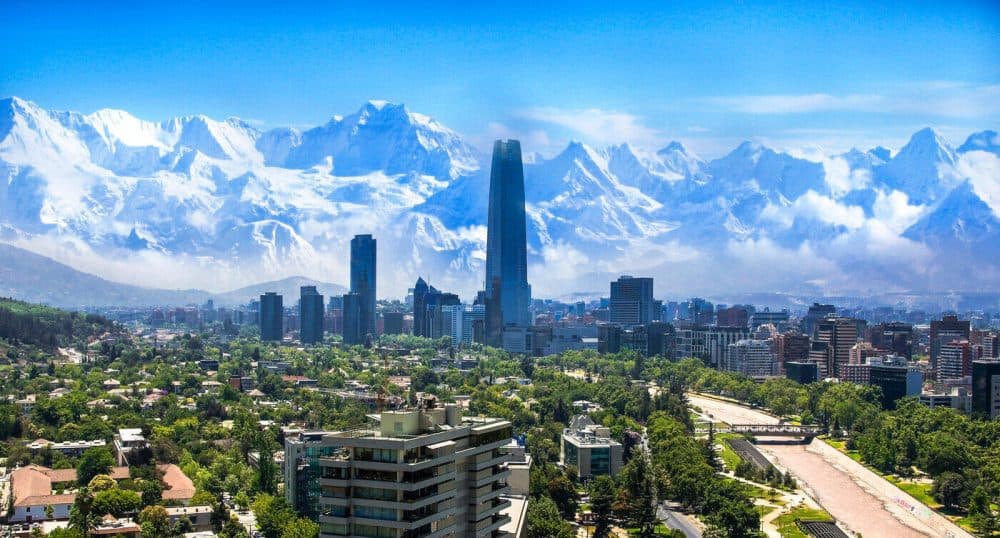
Santiago is Chile’s capital and by far its biggest city – roughly seven million people, close to four in ten Chileans, live in the greater metropolitan area. It sits in a basin in the Central Valley with the Andes rising straight out of its eastern suburbs, and it is where every Che Odyssey begins: a welcome day and a local tour before we load the bikes and head south for the vineyards of Colchagua, the Pacific coast, the volcanoes of the Araucanía and, eventually, the lakes and islands of Chiloé.
It is also a city Ernesto Guevara passed through in 1952, on the motorcycle journey that would turn a 23-year-old medical student into Che. So if you have a day or two either side of the tour, here is what we would do with it.
Che in Santiago
In January 1952 Ernesto Guevara and his friend Alberto Granado left Buenos Aires on La Poderosa II, a sputtering 1939 Norton 500. They crossed into Chile on 14 February by the old lake route from Bariloche – boats and short tracks across Lago Frías and Lago Todos los Santos, the emerald lake we finish beside at Petrohué on Day 23 – and rode north through Osorno, Valdivia and Temuco, cadging meals and beds as they went. The Mighty One did not survive Chile. Its frame broke near Lautaro, it limped on through Collipulli and Los Ángeles, and the pair arrived in Santiago on the back of a truck, leaving the motorcycle in a workshop “until further notice”. It never left.
Guevara was not overly impressed with the capital – he thought it looked a lot like Córdoba back home. From here they hitchhiked to Valparaíso, failed to find a boat to the leper colony on Easter Island, stowed away on a ship to Antofagasta and saw the copper miners of Chuquicamata, a sight he would not forget. Our tour rides much of his Chilean road in reverse, from Santiago south to the lakes he crossed on his way in.
The city carries two later threads of his story too. Che met Salvador Allende in Havana and gave him a copy of his book on guerrilla warfare, inscribed “to Salvador Allende, who pursues the same goals by other means” (Radio Universidad de Chile). Allende was elected President in 1970 and died in La Moneda palace during the coup of 11 September 1973 – the palace still stands at the heart of the old centre, and you can walk its courtyards. And Che was a lifelong reader of Pablo Neruda, whose Santiago house, La Chascona, is now a museum in Bellavista.
Getting your bearings
Santiago is not one city but dozens of comunas stitched together, and the ones that matter most to a visitor are Providencia, Lastarria, Bellavista, Las Condes, Ñuñoa and Santiago Centro itself. One great road ties them together. Coming down from the mountains in the east it is Avenida Las Condes, then Apoquindo, then Providencia and Nueva Providencia, before it enters the old centre as Avenida Libertador Bernardo O’Higgins – known to everyone simply as the Alameda.
The Metro follows much the same line and is the easiest way around: fast, clean and cheap, with seven lines and more being built. Our tour hotel sits a short walk from the Los Leones and Pedro de Valdivia stations.
When to go? Spring and autumn are the sweet spot – warm but not punishing, and the city full of life. The Che Odyssey departs in mid-November, late spring, when the jacarandas are out and the snow still lies high on the Andes behind the city. From December to March Santiaguinos leave town in their thousands for the coast and the lakes, and in winter (June to September) the ski resorts an hour or two up the road take over.
Santiago by day
Start high. Cerro San Cristóbal rises out of Providencia and Bellavista inside the Parque Metropolitano, the city’s great green lung – a funicular and a cable car (teleférico) carry you up past the botanical gardens, the public pools, the zoo and the hiking and mountain-bike trails to the summit, where a great white statue of the Virgin Mary looks out over the whole basin. On a clear spring morning the snow-capped Andes fill the eastern horizon.
Then walk the old centre. Cerro Santa Lucía is where Pedro de Valdivia founded Santiago in 1541, a rocky outcrop dressed up in the 19th century with the Neptune terrace, fountains, gardens and curving staircases that climb to a lookout. Across the road the Santa Lucía craft market sells everything from copper to alpaca, and behind it the cobbled lanes of Barrio París-Londres hide small shops and cafés.
Four blocks off the Alameda is the Plaza de Armas, the city’s original square, lined with the Metropolitan Cathedral, the National History Museum, the Central Post Office and the arcades of the Portal Fernández Concha, where Santiaguinos queue for a completo (Chile’s loaded hot dog) and a beer. Old men play chess under the gazebo. A short walk south is La Moneda, the presidential palace, with its Cultural Centre underneath – the building Allende never left in 1973.
Follow the river east through the Parque Forestal, Santiago’s oldest park, to the Museo Nacional de Bellas Artes, which shares its grand building with the Museum of Contemporary Art. West along the Mapocho is the Mercado Central, a 19th-century iron hall of fishmongers and seafood restaurants; cross the river to La Vega, its rougher, cheaper cousin, for mounds of fruit and vegetables and some of the best-value Chilean food in the city.
In Bellavista, La Chascona is the house Pablo Neruda built for Matilde Urrutia, now a museum full of his collections. Further out, Pueblito Los Dominicos in Las Condes is a quiet colonial-style craft village, and Parque O’Higgins south of the centre hosts the city’s biggest fondas every 18 September for Independence Day.
Santiago by night
Santiago eats late and goes out later, and its nightlife lives in its barrios. Bellavista, at the foot of San Cristóbal, is the bohemian one – Neruda’s old neighbourhood, now restaurants, theatres, street art and clubs playing anything from salsa to techno. Lastarria, just across the river from the Parque Forestal, is smaller and smarter: boutique hotels, wine bars, bookshops and some of the city’s best restaurants. Barrio Italia mixes design shops and galleries with relaxed bars and courtyards. Along Avenida Providencia, around Manuel Montt, pubs and restaurants keep going late, and in Ñuñoa, south-east of the centre, the bars around Plaza Ñuñoa are where the locals go.
Where to stay and where to eat
We base the Che Odyssey’s first night at Hotel Boutique Le Rêve in Providencia – leafy, quiet, close to the Metro and an easy walk to the restaurants. If you are arriving early, these are the hotels we like:
| Hotel | Neighbourhood | Why |
|---|---|---|
| Le Rêve | Providencia | Elegant boutique hotel and our tour hotel; near Los Leones and Pedro de Valdivia Metro |
| The Singular Lastarria | Lastarria | The smartest address in the old centre, steps from the Parque Forestal |
| OLA Providencia | Providencia | Modern, near Los Leones and Tobalaba Metro |
| TorreMayor Lyon | Providencia | A classic, near Los Leones and Pedro de Valdivia Metro |
| TorreMayor Providencia | Providencia | Modern sister hotel to the Lyon |
And where to eat:
| Restaurant | Neighbourhood | What for |
|---|---|---|
| Bar Liguria | Providencia | A Santiago institution – classic Chilean food and wine in an old-school bar |
| Bocanariz | Lastarria | Chilean wines by the glass, matched to small plates |
| Boragó | Vitacura | Rodolfo Guzmán’s tasting menu of wild Chilean ingredients, 6th in Latin America’s 50 Best Restaurants 2025 (Chile Travel) – book well ahead |
| Barandiarán | Providencia (Manuel Montt) | Peruvian classics – ceviche and pisco sour |
| Tiramisú | Las Condes | The city’s favourite pizza |
| Rivoli | Providencia | Long-standing Italian |
| Le Bistrot | Providencia and Lastarria | French bistro cooking and our first dinner on tour |
Beyond the city
Wine first. The Maipo Valley runs right to Santiago’s southern edge, and historic estates such as Concha y Toro in Pirque, Cousiño Macul and Santa Carolina are close enough for an afternoon tour and tasting – a fitting warm-up, because Day 3 of the tour is a winery loop around Santa Cruz in the Colchagua Valley.
About an hour east, the Cajón del Maipo is Santiago’s playground, a deep Andean canyon for hiking, riding, horse trekking and rafting on the Río Maipo. Across the river from Pirque, the Reserva Nacional Río Clarillo has picnic spots, trails and summer swimming holes. West of the city, the little town of Pomaire is famous for its cheap, handsome clay pottery and for huge empanadas. In winter the ski fields of Farellones, La Parva, El Colorado and Valle Nevado are barely an hour or two above the city, with Portillo further up the road to Mendoza.
Riding south
After the welcome day, we leave the city behind. A two-hour shuttle takes us to Santa Cruz and the vineyards of Colchagua for our warm-up loop, and from there the road runs south for four weeks… to the surf town of Pichilemu and down the wild Pacific coast through Constitución and Curanipe, up into the araucaria forests of the Andes at Corralco and Lonquimay, on to Pucón beneath the smoking cone of Volcán Villarrica, through the Seven Lakes to Huilo Huilo, Lago Ranco, Puyehue and Petrohué, across to the wooden churches of Chiloé, and finally up the flanks of Volcán Osorno above Puerto Varas.
It is the country the young Ernesto Guevara rode through, broke down in and talked his way across in 1952, taken at the pace of a bicycle and with a far better hotel at the end of each day. Santiago is the start line.