
Over 28 days and five nations, from London to Edinburgh, the Britannia tour rides through roughly five thousand years of history – from the stones of Salisbury Plain to the murals of Derry. The catch? It never comes in order. On Day 2 you are standing beside Stonehenge; on Day 3 you are soaking in a Roman spa; by Day 12 you are in a Dublin gaol where the leaders of the 1916 Easter Rising were shot, and two weeks later you are back in the 13th century, looking down on the field where William Wallace beat an English army at Stirling Bridge.
So rather than walk you through the tour day by day (the itinerary does that), this post untangles it. We have laid the history out as a timeline, era by era, and pinned each piece to the place on the route where you will meet it. Read it in order and a story appears – a story of invaders and settlers, saints and kings, conquest and rebellion, of four peoples who spent two thousand years shaping, fighting and borrowing from each other… and of the roads, walls and castles they left behind for us to ride past.
Before history: the stone builders (c. 3000 – 1500 BC)
The oldest thing we ride past is also the most famous. Stonehenge (Day 2) was begun around 3000 BC and reworked over the next thousand years or more, its great sarsens dragged across Salisbury Plain and its smaller bluestones hauled, astonishingly, from the Preseli Hills of west Wales. Nearby Woodhenge was only discovered in 1925, spotted from the air as rings of dark marks in a crop field. Nobody can tell you exactly what these places were for, and that is half the fun of standing beside them.
Romans at the edge of the world (AD 43 – c. 410)
To the Romans, Britannia was the edge of the known world – and the name itself, as we explore in Why Britannia?, is one of the threads that runs through this whole tour. They arrived in force in AD 43 and stayed nearly four centuries. Bath (Day 3) was their spa town, Aquae Sulis, built in the 1st century AD around the only hot springs in Britain and dedicated to a goddess who was half Celtic Sulis, half Roman Minerva. The next day we ride into Cirencester, Roman Corinium, once the second-largest town in the province. The Romans never conquered Ireland, and never held the Highlands for long… which matters later in the story.
Saints, scribes and the Irish Scots (c. 400 – 900)
When Rome left, the light moved west. Ireland became a land of monasteries and manuscripts, and in Dublin (Day 12) we see the Book of Kells at Trinity College, a 9th-century gospel book so richly illuminated it is hard to believe it was made by hand. In 563 the Irish monk Columba crossed to Iona, just off Mull (Day 24), and founded the monastery that carried Christianity into Scotland.
And here is a twist most riders do not expect. Crossing from the Antrim coast to Arran and Argyll (Days 19 – 22), we follow the sea-lane of Dál Riata, an early kingdom that straddled both shores. Its people were the Scoti, Gaelic-speaking settlers from Ireland – and they eventually gave their name to Scotland itself.
Saxons, Vikings and Normans (c. 850 – 1200)
On Day 1 we ride into Winchester, capital of Alfred the Great’s Wessex, the kingdom that held out against the Vikings in the 870s and became the seed of England. The Vikings, meanwhile, were busy founding towns of their own – Dublin among them – and Dublin’s Christ Church Cathedral began as a Hiberno-Norse church in the 11th century. Then came 1066. The Normans rebuilt Winchester Cathedral on a vast scale, and in the Cotswolds we pass the 12th-century Malmesbury Abbey, where Athelstan, the first king to rule all England, is buried.
Castles, conquest and the wars of independence (1200 – 1400)
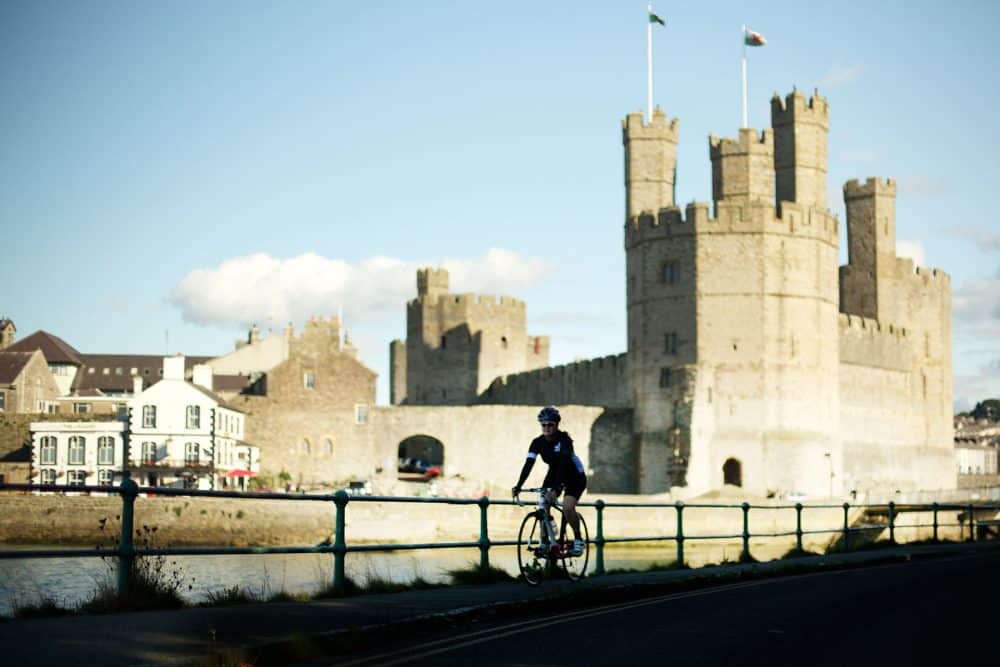
The 13th and 14th centuries are when the four nations really collide. Salisbury’s soaring cathedral (Day 1) was built in barely 40 years from 1220, and holds one of the four surviving original copies of Magna Carta. In Wales, Edward I ringed Gwynedd with castles after the death of its last native prince, Llywelyn ap Gruffudd, in 1282 – and Caernarfon (Day 9), begun in 1283, was the grandest of them all, built to look like the walls of Constantinople. Around Eryri (Day 10) we hear a much gentler story, the 13th-century legend of Prince Llywelyn and his faithful hound Gelert at Beddgelert.
Edward then turned on Scotland, and the tour ends where that fight was decided. At Stirling (Day 26) the Wallace Monument looks down on the site of the 1297 Battle of Stirling Bridge, and a few kilometres away Robert the Bruce won Scotland’s independence at Bannockburn in 1314. On Arran (Day 21) we also meet the Bruce’s legend, the cave where he is said to have watched a persevering spider and found the will to fight on.
Tudors, Stuarts and the age of upheaval (1500 – 1700)
Stratford-upon-Avon (Days 6 – 7) is all about one man: William Shakespeare, born here in 1564 and schooled in the Guildhall, built in 1420, that still stands in the town. Beyond the stage, this was an age of fracture. Mary, Queen of Scots was born at Linlithgow Palace in 1542, which we pass on our last ride into Edinburgh (Day 27). In Ulster, the Plantation brought English and Scottish settlers, and Derry’s walls (Days 16 – 17) were built between 1613 and 1618 – then held through the famous siege of 1689. The Cotswold town of Burford (Day 5) remembers the English Civil War, when Oliver Cromwell imprisoned mutinous Levellers in its church in 1649 and had three of them shot. And in the freezing February of 1692, at Glencoe (Day 25), government soldiers turned on their MacDonald hosts in the massacre that still haunts that valley.
Georgians, revolution and famine (1700 – 1900)
The 18th century gave us the Bath we see today, its golden Georgian crescents built when the city was the most fashionable resort in Britain – and the Edinburgh of the Enlightenment, home to David Hume and Adam Smith. In 1798 the west of Ireland rose in rebellion, and a small French army landed at Killala Bay near Ballina (Day 15) to join it. Half a century later, the Great Famine of 1845 – 1852 emptied this same coast; County Mayo, which we ride through from Westport, was among the hardest hit. In Dublin’s Kilmainham Gaol (Day 12) we glimpse the harsh realities of 19th-century prison life.
The twentieth century: rising, war and the Troubles (1900 – 1998)
The modern era is the closest to us, and in some places the most raw. The 1916 Easter Rising began the road to Irish independence, and its leaders were executed at Kilmainham. In Connemara (Days 13 – 14), Alcock and Brown crash-landed in a bog near Clifden in 1919 at the end of the first non-stop transatlantic flight, and Kylemore Abbey was taken over by Benedictine nuns who had fled Belgium during the First World War.
The Second World War left its mark too, if more quietly. Bath was bombed in the Baedeker raids of April 1942. Derry became a vital Allied base in the Battle of the Atlantic, and in May 1945 the surrendered U-boats were brought into nearby Lisahally. On Mull, Tobermory’s sheltered harbour became HMS Western Isles, the training base where escort ship crews were drilled for the Atlantic convoys. In Eryri, the Pen-y-Gwryd Hotel was the training base for the team that made the first ascent of Everest in 1953.
And in Derry we come face to face with the Troubles – Bloody Sunday in 1972, the murals of the Bogside, and a city that has done the hard work of moving beyond them since the 1998 Good Friday Agreement. We do not soften this history, and we do not need to. The city tells it best itself.
One story, told out of order
Put it all back in sequence and the tour stops being a list of famous places and becomes a single, tangled story. Stone builders, then Romans, then Irish monks carrying the faith east and Irish settlers carrying a name to Scotland. Saxon kings holding off Vikings, Norman cathedrals, Edward I’s castles and the Scots who threw him back. Plantations and sieges, crescents and famine, risings, world wars and, finally, peace. You ride it in the wrong order… and somehow, by the time you roll into Edinburgh, it makes more sense that way.
Each of these chapters deserves a post of its own, and over the coming months we will be digging deeper – into Edward I’s iron ring of castles, the Dál Riata crossing that made Scotland, Derry’s walls from 1613 to the Troubles, and the hidden Second World War stories of the Atlantic coast. In the meantime, the best way to read this history is from the saddle.