

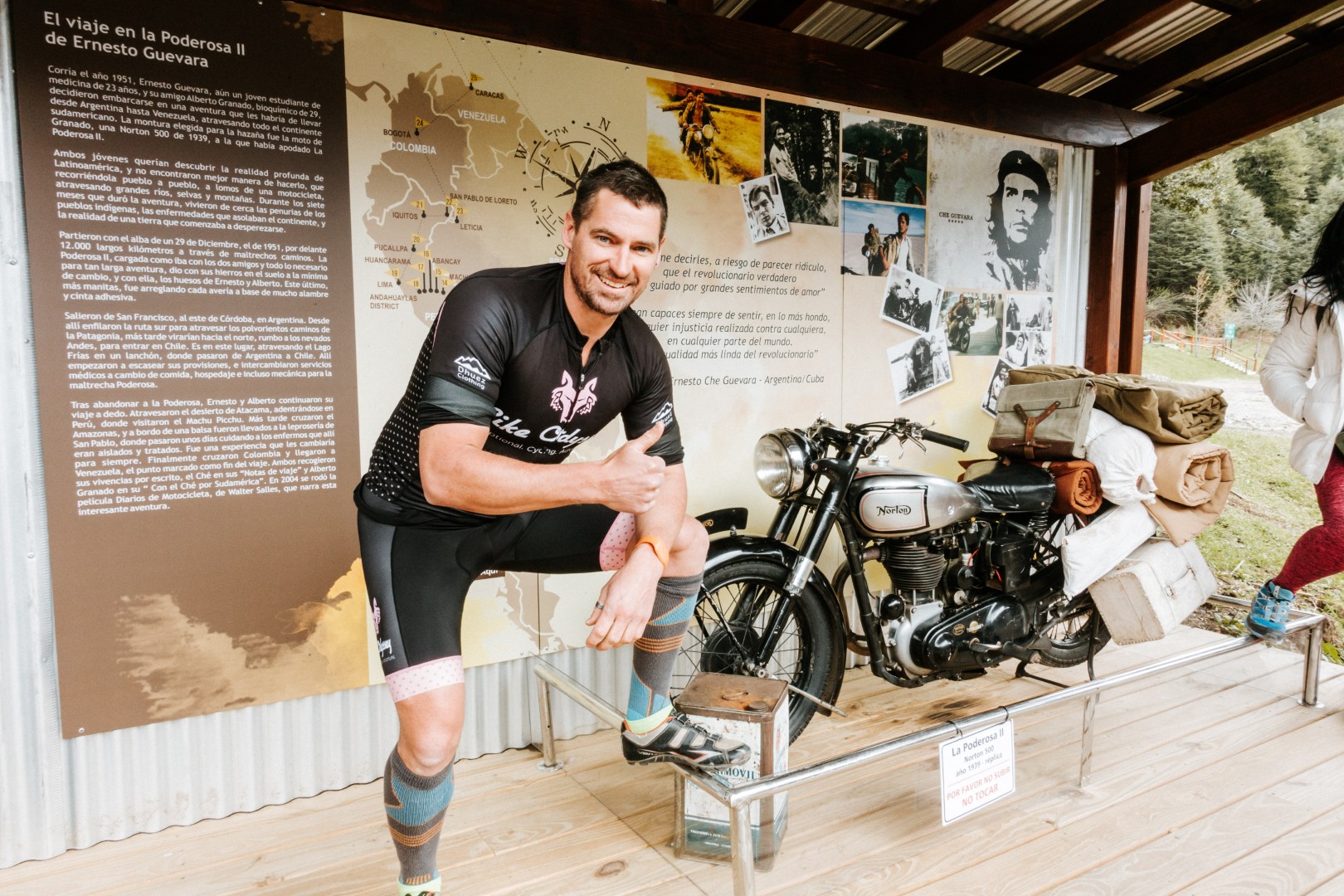
In February and March 1952, a 23-year-old medical student called Ernesto Guevara and his friend Alberto Granado rode a worn-out 1939 Norton 500 across the Andes from Bariloche into Chile. They crossed the border by boat at Peulla on 14 February, then pushed north through Petrohué, Osorno, Valdivia, Temuco and Lautaro, until their motorcycle, La Poderosa II – “The Mighty One” – died on a hill near Collipulli. From there they hitched to Los Ángeles, Santiago and Valparaíso, stowed away on a ship to Antofagasta and crossed the Atacama to the copper mine at Chuquicamata. Five weeks in Chile. It is the stretch of The Motorcycle Diaries where the joker on the motorbike starts to become Che… and it is the country we ride through on our Che tour.
Here is that story, place by place.
Two men and a Norton
The plan was hatched over sweet mate under a vine in Córdoba in October 1951. Granado, a 29-year-old biochemist who had been working at a leper colony, and Guevara, a restless medical student with chronic asthma and a year of study still to go, decided they would ride to North America. On what? On Alberto’s Norton, of course. To keep their families calm, they told everyone they were only going to Chile.
They left Buenos Aires in early January 1952, with the bike overloaded, the luggage rack sitting behind the centre of gravity and the front wheel constantly trying to lift. On their first day of gravel they crashed nine times. Guevara burnt his foot on the cylinder. He caught a fever and was dosed with a little-known new drug, penicillin, in the hospital at Choele Choel. The frame snapped and was held together with wire. They shot a duck, a caretaker’s dog (mistaking it for a puma in the dark) and most of their remaining credibility. By the time they reached the Andean lakes of Argentine Patagonia, at San Martín de los Andes and along the Seven Lakes Road, they had become very good at one thing – talking strangers into feeding them.
Across the Andes by water
The route into Chile was not a road at all. In mid-February 1952 they loaded La Poderosa on to the steamer Modesta Victoria at Bariloche and crossed Lago Nahuel Huapi to Puerto Blest, rode a few kilometres to emerald Lago Frías, crossed that, passed Argentine customs, climbed over the low pass at this latitude and dropped to the Chilean post at Peulla. Then one more lake – Todos los Santos, which Guevara knew as Esmeralda – in a leaking old barge, the two of them pumping out the bilge water to pay for their passage and the bike’s.
It is the same chain of lakes, boats and border posts that the Cruce Andino uses today, and at Puerto Frías there is now a replica of La Poderosa for the day trippers to photograph. Above it all stand Tronador, Puntiagudo and Osorno, three volcanoes that watch over this corner of the Andes. Guevara looked down from a lookout at Casa Pangue and saw the narrow band of Chile ahead of him as a kind of crossroads. He was right, though he had no idea yet which road he would take.
The lake route ended at Petrohué. A man there needed a station wagon driven to Osorno, so Guevara – who could barely drive – had a high-speed lesson in changing gears from Alberto and set off. The road skirted Lago Llanquihue with Volcano Osorno standing over it like a sentinel. Guevara saw almost none of it, busy as he was with brake, clutch, first, second, and one unfortunate pig.
“Two Argentine leprosy experts”
In the boat on Todos los Santos they had met Chilean doctors who admitted they had never seen a case of leprosy, because Chile barely had the disease. The Argentines, who had seen some, inflated themselves into world authorities on the spot. The doctors mentioned a small leper colony on Easter Island, Rapa Nui, and a scheme was born – they would get themselves a free voyage to the Pacific as visiting experts.
They worked the scam all the way north. In Valdivia, which was celebrating its 400th anniversary, they called into the Correo de Valdivia and walked out with an article about themselves. In Temuco, El Diario Austral ran the famous headline – Two Argentine Leprosy Experts Tour South America by Motorcycle – and noted that they wanted to visit Rapa Nui. The family they were staying with gathered round the newspaper in awe. Guevara, looking back, was honest enough to call it the high point of their audacity.
Between the jokes, though, he was noticing things. The tidy, intensely farmed plots of southern Chile, so different from his own arid south. The wooden houses, the huasos in their ponchos, a country that felt to him more indigenously American than Argentina did. And everywhere, the famous Chilean hospitality that he says he never tired of praising.
Lautaro and the death of La Poderosa
North of Temuco the bike began to fall apart for good – a broken steering column, a smashed gearbox. In the small town of Lautaro a mechanic took it on, and the grateful experts were invited to a dance. Wine flowed, and Guevara tried to steer a married woman outside. Her husband noticed. The leprosy experts left Lautaro with an angry crowd behind them. (The 2004 film gives this escapade to Alberto. The diary is quite clear it was Ernesto.)
A few days on, after a near miss with a herd of cattle, La Poderosa gave its last gasp on a steep hill near Collipulli in the Malleco country. A truck carried the bike and its riders to Los Ángeles, where they talked their way into the volunteer fire station, stayed several nights and turned out in the middle of the night to a real house fire. Then another truck took them, and the corpse of the Norton, to Santiago, where it was left in a garage. It never moved again.
From here on they were not “motorized bums” with an exotic machine. They were simply two hitchhikers.
Valparaíso and La Gioconda’s smile
On 7 March 1952 they reached Valparaíso. There was no ship to Easter Island for another six months, so the great Rapa Nui scam died along with the motorbike. The owner of a little bar called La Gioconda fed them for free, and asked Guevara to look in on one of his customers, an old woman with asthma and a failing heart.
It is one of the turning points of the whole book. Guevara, an asthmatic himself, could do almost nothing for her. He found her in a small, airless room, too sick to work, and treated by her own family as a burden for it. He wrote with real anger about a world where a poor woman’s illness makes her an enemy to the people around her, and about the uselessness of a doctor’s sympathy against that. He left her what pills he had. It is the first time in the diary that the jokes stop entirely.
Soon after, the two of them stowed away on the freighter San Antonio. Discovered at sea, they worked off their passage scrubbing the ship to Antofagasta.
Chuquicamata: the making of a revolutionary
From Antofagasta they hitched inland across the Atacama towards Chuquicamata, then the largest open-pit copper mine on earth and the economic heart of Chile – and owned by American companies. Near Baquedano, on a freezing desert night, they shared a fire with a married couple, Chilean workers who had been persecuted and jailed for being communists, and who were now wandering the desert looking for work in the mines. They had no blanket. Guevara and Granado gave them one of theirs.
Guevara saw in that couple, huddled together in the cold, the workers of the whole world. At the mine itself he asked a foreman about the miners who had died there, a question the man said he was rarely asked. His verdict on Chile, written later, was that the country’s greatest task was to free itself from its uncomfortable Yankee friend – a line that tells you exactly where his thinking was heading. They left Chile through Iquique and Arica late in March and went on to Peru, the Amazon and the San Pablo leper colony.
When he typed up his notes back in Argentina, Guevara wrote that wandering Our America had changed him more than he thought. The man who wrote the notes, he said, had died the moment he set foot on Argentine soil again. Seven years later he was in Havana, a comandante of Fidel Castro’s victorious revolution.
Che: a man to be loved or loathed
It is impossible to write about Che without saying this plainly. He is a hero on a T-shirt to millions, and to many Cubans and others he is something much darker – the man who signed execution orders without trial at La Cabaña prison after the revolution, and who believed violent revolution was the only answer to the poverty he saw on this journey. He was captured and executed in Bolivia in October 1967, aged 39. On our tours we have had riders who revere him and riders who detest him, sometimes at the same dinner table, and the conversations are among the best of the trip.
What is not in dispute is that the young man of The Motorcycle Diaries – funny, broke, shameless, curious and increasingly angry – was formed on roads in Chile. That is why we built a tour around it.
Riding the Motorcycle Diaries route by bicycle
Our first Che exploration ran from Bariloche to Santiago and crossed the Andes exactly as Che and Alberto did – the Seven Lakes Road, Nahuel Huapi, Lago Frías and the boat across Todos los Santos. Our guide Max and photographer Chris scouted that crossing in November 2017, by road and catamaran, while I (Sam) drove around with my son Jack, then 8 – this was when i got to know Harry Potter by Stephen Fry too well!
Today’s Che – Santiago to Volcano Osorno rides Che’s Chile in the other direction, starting where La Poderosa was laid to rest. You leave Santiago for the wine valleys of Casablanca, Maipo and Colchagua, roll down the Pacific coast through Pichilemu and Curanipe, then turn inland across the Araucanía he hitchhiked through, climbing into monkey puzzle forest beneath the smoking Volcano Lonquimay. From Pucón and Villarrica you work south through the Lake District, cross to Chiloé, and finish by circling Lago Llanquihue – the road Che drove in that borrowed station wagon – before the final climb up Volcano Osorno, the sentinel he saw over his shoulder on his first day in Chile.
It is 2,148km over 29 days, averaging 78km and 900m of climbing a day, on quiet roads, with lodges in the national parks, designer hotels on the coast and some very good Carmenère along the way. You do not need to sleep in a fire station or talk your way into dinner. Che and Alberto would have been appalled… and secretly envious.
The next departure is tomorrow, 11 November, 2026! But for those interested in joining us – 8 November to 6 December 2028, and you can ride the full Odyssey or either stage. See the full Che tour, dates and prices, or read more about Che Guevara himself.
Frequently asked questions
What route did Che Guevara take through Chile in The Motorcycle Diaries?
Guevara and Granado crossed from Bariloche by the Andean lakes to Peulla on 14 February 1952, then travelled via Petrohué, Osorno, Valdivia, Temuco, Lautaro, Los Ángeles, Santiago and Valparaíso. They took a ship to Antofagasta, visited the Chuquicamata copper mine and left Chile through Iquique and Arica for Peru in late March 1952.
Where did La Poderosa break down?
The motorcycle suffered a string of failures after Temuco and finally gave out on a hill near Collipulli in Chile’s Malleco region. The riders hitched to Los Ángeles, then took the bike by truck to Santiago, where they abandoned it in a garage.
Did Che Guevara go to Patagonia?
Yes. Before entering Chile he rode through Argentine Patagonia, including San Martín de los Andes, the Seven Lakes Road and Bariloche on Lago Nahuel Huapi, then crossed the Andes into Chile’s Lake District by boat.
Can you cycle the Motorcycle Diaries route?
Yes. Bike Odyssey’s Che tour is a fully supported 29-day cycling tour through Chile from Santiago to Volcano Osorno, passing through the regions Che and Alberto crossed in 1952, from the central valleys and the Araucanía to the Lake District and Lago Llanquihue.