Say “Viking” and most people picture the same thing: horned helmets, burning monasteries, a longship full of raiders descending on some unsuspecting coastal village. It’s a good story. It’s also mostly wrong and it does a disservice to one of the most accomplished seafaring, trading and exploring cultures in European history.
Our Vikings cycling tour doesn’t just ride through Scandinavia. It rides through the actual geography that produced these people: the flat, fertile plains of Denmark where they farmed and built their first towns (briefly!), and the deep, cliff-walled fjords of western Norway that forced them onto the water in the first place. Copenhagen to Ålesund isn’t a route we picked just because it’s scenic (although it is, spectacularly!). It’s a route that happens to trace the real Viking world, stop by stop.
Raiders, or something more complicated?
The raiding did happen – Lindisfarne in 793 is usually cited as the opening shot of the Viking Age, and it was every bit as brutal as the monks who recorded it claimed. But raiding was a sideline, not the business model. The same clinker-built ships that could beach on an English shore and disgorge armed men could just as easily carry furs, walrus ivory, amber and slaves to trade in Baghdad, or settlers and livestock to a farm in unclaimed Iceland.
Vikings served as the Byzantine emperor’s personal bodyguard in Constantinople (the Varangian Guard). They ran the river trade routes through Russia – the name “Rus” itself probably comes from Norse settlers. They reached Greenland, and briefly, Newfoundland, five centuries before Columbus. They were poets: the sagas and Eddas they left behind are some of the richest literature to survive the early medieval world. None of that fits on a horned helmet, which is just as well, because the horned helmet is a 19th-century costume-design invention. No Viking ever wore one into battle.
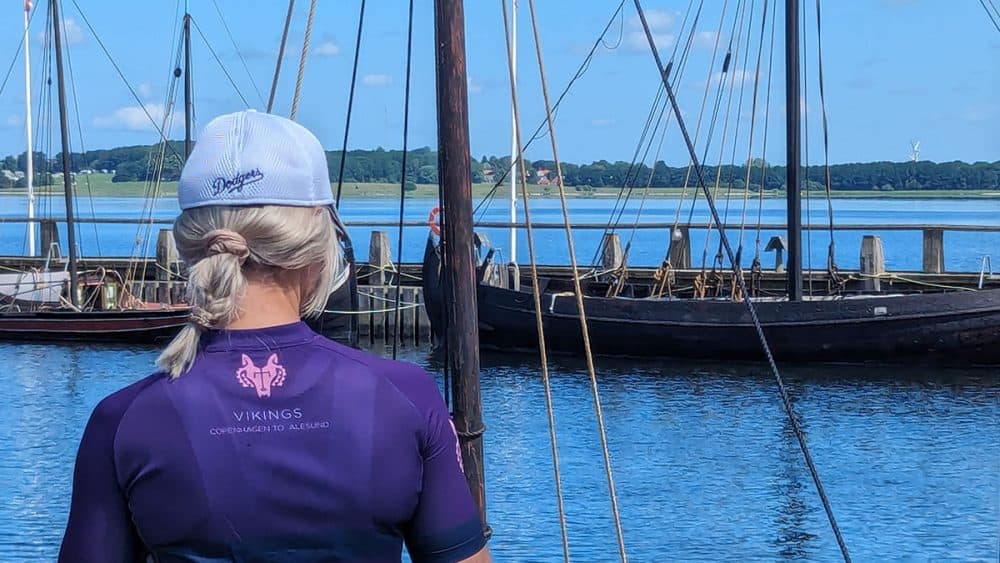
Roskilde: where the ships tell the truth and where the photo is take above!
Our first real Viking landmark isn’t far out of Copenhagen. Roskilde’s Viking Ship Museum houses five vessels – the Skuldelev ships – deliberately scuttled around 1070 to block a channel and protect the town from seaborne attack. They were pulled from the fjord mud in the 1960s, and between them they cover the full range of what a Viking-Age ship actually was: a slender, fast warship built for speed and shallow beaches; a broad-beamed ocean trader built to haul cargo, not warriors; a small ferry for coastal work; a fishing boat. It’s the single best place in the world to understand that “Viking ship” wasn’t one design – it was a whole toolkit, engineered for very specific jobs.
Aarhus and Jutland: older than the postcards suggest
Aarhus today reads as clean, modern, thoroughly Danish. Underneath it is Aros – one of the oldest fortified trading towns in Denmark, established in the 10th century at the mouth of the Aarhus river, defended by a semi-circular rampart whose outline archaeologists have traced beneath the modern street plan. It was a working port: grain, cattle and craft goods moving in and out under the same rulers who were, depending on the decade, either fighting the Franks or intermarrying with them. Riding through it is a reminder that most Viking towns weren’t isolated farmsteads – they were networked, urban, and commercially sophisticated for their time.
Just outside Aalborg, on a sandy ridge overlooking the Limfjord, sits one of the largest Iron Age and Viking burial grounds in Scandinavia: nearly 700 graves spanning roughly 400 to 1000 AD. What makes Lindholm Høje remarkable isn’t just its size – it’s that many of the graves are marked with stones laid out in the shape of a ship, the dead sent off, symbolically, exactly the way they’d have travelled in life. The site was gradually swallowed by drifting sand centuries ago, which sounds like a disaster and was actually a stroke of luck: it sealed the graves untouched until archaeologists rediscovered them in the 20th century. It’s now an open-air museum, and one of the few places on this route where you can stand in the middle of an entire Viking-Age community’s final resting place at once.
Crossing into the fjords
Somewhere between Denmark’s flat farmland and the Norwegian coast, the landscape stops explaining Viking history and starts being it. Telemark’s fjords and stave churches are the hinge point of the route, and from here the geography does something Denmark’s gentle plains never could: it corners you. A Norwegian farmer on a fjord-side strip of arable land, boxed in by mountains on three sides, has exactly one practical way to move people, animals, timber and goods – by water. That single geographic fact is arguably the real origin of Viking seafaring. It wasn’t a cultural quirk. It was the only option.
Bergen: built right at the end of the story
It’s a nice irony that Bergen – our gateway to the fjords proper – was founded right as the Viking Age was closing out. Tradition credits King Olav Kyrre (Olav “the Peaceful,” son of the famously less peaceful Harald Hardrada) with founding the town around 1070, just five years after the Battle of Stamford Bridge is generally taken to mark the end of the Viking Age in England. Bergen grew fast into a major trading gateway – later the Hanseatic League’s northernmost major post – because it sat exactly where Norway’s fjord world met the open sea. It’s less a Viking ruin than a Viking result: the kind of organised, permanent trading settlement that the raiding-and-trading economy of the preceding centuries had been building toward all along.
The real Viking heartland: Hardangerfjord and Sognefjord
From Bergen, the route runs through Hardangerfjord and Sognefjord – the second-longest and the longest fjords in the world respectively — and this, more than anywhere else on the tour, is the Viking heartland in the sense that matters: not where they raided, but where they lived. Steep, narrow, glacier-carved valleys with a sliver of farmable land at the fjord’s edge and nothing but water leading out. Boatbuilding wasn’t a specialist trade here so much as a survival skill, passed down alongside farming and fishing. The same engineering that produced the ocean-crossing knarr also produced the small, everyday fjord boats that got a family from their farm to church, or to market, or to a neighbour three headlands over. Riding this stretch, with the water on one side and rock walls on the other, makes the “why” of Viking shipbuilding obvious in a way no museum ever quite manages.
How far did they actually go?
Iceland, first settled by Norse farmers in the 870s. Greenland, from around 985. A short-lived settlement at L’Anse aux Meadows in Newfoundland, dated to roughly 1000 AD – genuine, archaeologically confirmed Norse presence in North America, five hundred years ahead of the history most of us were taught in school. East, along the Dnieper and Volga river systems, Norse traders reached the Caspian and Black Seas and did business with the Abbasid Caliphate; Arabic silver coins turn up regularly in Scandinavian Viking-Age hoards. This wasn’t a culture that lashed out blindly at its neighbours. It was one of the most far-ranging trade and settlement networks Europe had ever produced, built entirely on ships designed in places exactly like the fjords this tour rides through.
Trollstigen, the Atlantic Road, and the end of the line
The tour’s final stretch – the switchbacks of Trollstigen and the causeways of the Atlantic Ocean Road into Ålesund – is modern engineering solving the same problem Vikings solved with boats: how do you move through a landscape this vertical? We get tarmac and bridges. They got clinker-built ships and an intimate, hard-won knowledge of tide and current. Both are, in their own way, remarkable answers to the same question this whole coastline keeps asking.
A historian who answers to the name honestly
You don’t have to take our word for any of this on tour. Thor Schei Hellesnes is the historian who joins our Vikings Odyssey, and he has, by his own admission, the easiest job title in the company – “no need for a Viking nickname when your name is Tor!” Beyond the obvious, Thor brings genuine Nordic medieval scholarship to the route, including a soft spot for Øystein Morten’s writing on Erik the Red, and a local’s feel for Norway’s roads that runs deep enough to have opinions on which mountain pass is objectively the best (he’ll tell you it’s the Rallavegen, and he’ll admit that’s “a bit influenced by local patriotism”). Ride with him and the history in this post stops being background reading and starts being the person pedalling next to you.
Riding Copenhagen to Ålesund won’t make you an expert on the Viking Age – a lifetime of archaeology hasn’t fully done that for anyone. But it will put you, on a bike, in the exact places that produced this history: the trading towns, the ship timbers, the fjords that left people no option but the sea. That’s a better way to understand the Vikings than any horned helmet ever was.
Ready to ride it? Take a look at the Vikings – Copenhagen to Ålesund tour page for the full itinerary.