

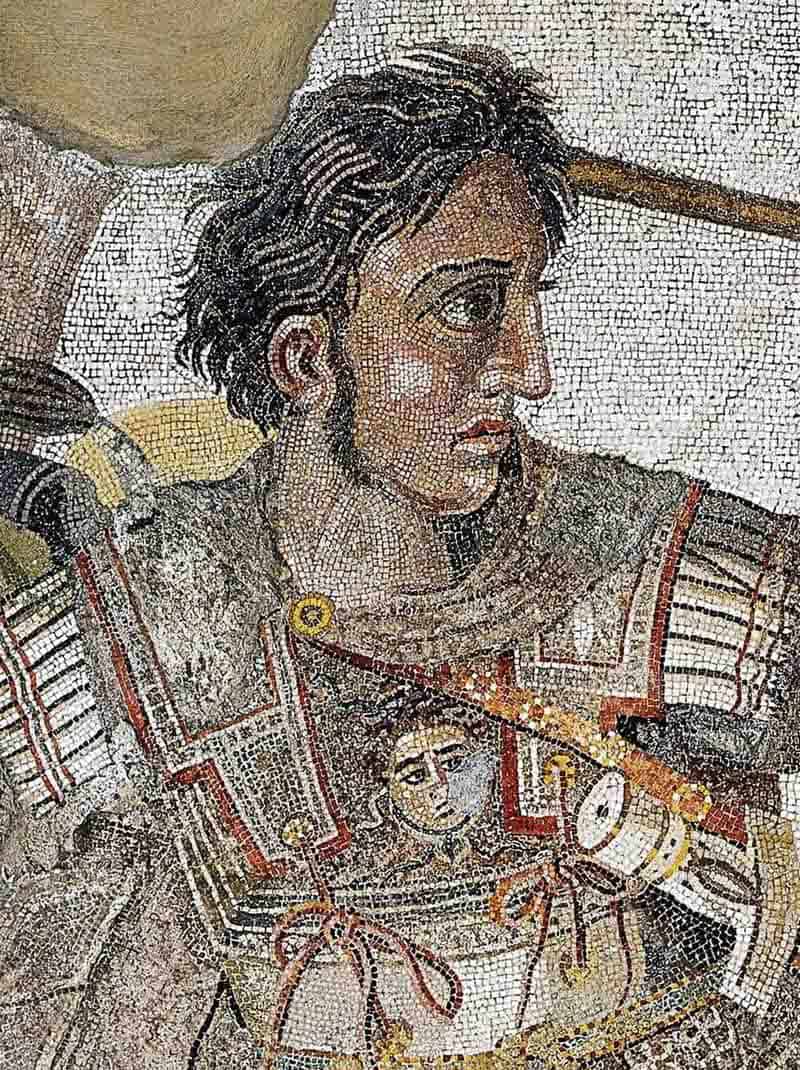
Ask most people to draw Alexander the Great’s route and you’ll get a vague arrow pointing east – Greece, then somewhere hot, then India. The real Alexander the Great route from Greece to Egypt is far more specific, and far more or rideable than that. It runs through actual towns with actual roads: Pella to Vergina, down through Thessaly to Thermopylae, along the Lycian coast of southern Turkey, and finally across the Mediterranean into Egypt. We built our Mt Olympus to Cairo Odyssey directly on top of it. Here’s the history, in order, as it actually happened.
Pella: where the boy became the general
Alexander was born in Pella in 356 B.C., then the capital of a Macedonian kingdom most of Greece still regarded as a barbarous backwater. His father Philip II had other ideas. In a single decade Philip had turned Macedon into the dominant military power in the Greek world, rearming his infantry with the sarissa, a four- to six-metre pike, and building siege engines that could reduce a city wall to rubble in days. Alexander grew up inside that machine, tutored not far from here at Mieza by Aristotle himself, and by the time he was a teenager he was already commanding cavalry.
Philip’s ambitions ended at Chaeronea in 338 B.C., where he crushed the combined armies of Athens and Thebes and brought all of Greece under Macedonian control. Two years later, in 336 B.C., an assassin’s blade cut him down at Aigai (modern Vergina) and the 20-year-old Alexander was proclaimed king over his father’s open grave.
That grave is still there. Philip’s tomb at Vergina, excavated less than fifty years ago, was found untouched: silver chalices, an ivory-and-gold shield, a full suit of gilded armour, all exactly as they were left in 336 B.C. Standing in that chamber, a few days into the ride south from Pella, is as close as this Odyssey gets to the exact hinge-point of the whole story – the morning a Macedonian prince became the man who’d conquer the known world.
Olympus, Meteora, and a debt to Thermopylae
From Vergina the route climbs toward Mount Olympus, mythical seat of the gods and, not coincidentally, the mountain under which Alexander was happy to let people believe Zeus was his real father. He never discouraged the rumour. It suited him. Further south, through the stone pillars of Meteora, the road eventually reaches Thermopylae – the pass where, 150 years before Alexander was born, Leonidas and 300 Spartans held off Xerxes’ Persian army long enough to buy Greece the time it needed to survive. That Persian invasion, and the century and a half of grievance it left behind, was the pretext Alexander used to invade Persia himself. He framed his entire eastern campaign as Greek revenge for Thermopylae. Riding through the pass on the way south, it’s worth remembering that this isn’t scenery, it’s the reason the rest of the journey happened at all.
By 335 B.C. Alexander had already had to march back through central Greece once, to put down a revolt in Thebes after a rumour of his death spread following a campaign against the Illyrians. He razed the city and sold its survivors into slavery, a brutal object lesson that kept the rest of Greece quiet while he turned his attention east. In 334 B.C. he crossed into Asia with 43,000 infantry and 5,500 cavalry, the largest force Greece had ever sent abroad, and famously hurled a spear into the sand as he landed, declaring the whole of Asia “spear-won.”
The Turquoise Coast: Alexander’s actual campaign trail
This is where most retellings of Alexander skip straight to Issus and Gaugamela. But his real route south from the landing point ran along exactly the coastline our gulets sail today. After freeing the Greek cities of Ionia from Persian garrisons, Alexander marched down through Caria and into Lycia, accepting the surrender of city after city along what’s now called the Turquoise Coast – Kaunos, Xanthos, the coastal towns around modern Fethiye and Kalkan. Lycia gave him almost no resistance. Pamphylia, the stretch around modern Antalya, gave him even less.
Pisidia, in the mountains just inland, was a different story and it’s where the tour’s history gets genuinely dramatic. At Termessos, a fortified Pisidian stronghold perched over 1,000 metres up in the Taurus Mountains, Alexander found a city he simply could not take. The Termessians held the high passes, the terrain favoured no army on earth, and after assessing the position, Alexander made the rare call to walk away rather than lose men storming an unwinnable siege. Sagalassos, another Pisidian city not far off, got a very different outcome: Alexander stormed it, took its allies, and forced its submission. Two cities, a few days’ ride apart, and two completely opposite endings, one of the clearest illustrations anywhere of Alexander knowing exactly when to fight and when not to and where we end our Turkish cycling leg.
From Pisidia the historical Alexander pushed on to Gordium, where he cut, or, depending on which ancient source you trust, hacked apart, the Gordian Knot, before turning south through the Cilician Gates toward his first great pitched battle against Darius III at Issus, and eventually the long siege of Tyre. That inland leg isn’t part of this Odyssey; ours follows Alexander’s coastal campaign by water, the way his supply fleet would have shadowed his army, before leaping ahead by air to catch up with him at his next major stop: Egypt.
Egypt: a conquest without a battle
By the time Alexander reached Egypt in 332 B.C., the Persian satrap governing it had already decided not to fight. Egypt, worn down by Persian rule, more or less welcomed him. He was crowned Pharaoh at Memphis, near modern Saqqara, and founded a city on the Mediterranean coast that would outlive his entire empire – Alexandria, seat of the Ptolemaic dynasty for the next 300 years and home, eventually, to two more wonders of the ancient world: the Great Library and the Lighthouse of Pharos. Neither survives today, which is why this Odyssey doesn’t detour to Alexandria and instead follows Alexander inland, along the Nile, to the monuments that do.
At Saqqara stands the Step Pyramid of Djoser, the first pyramid ever built and already more than two thousand years old by the time Alexander’s army passed nearby. At Giza, the Great Pyramid and the Sphinx had been standing for a full millennium before Alexander was even born – ancient to him in exactly the way Alexander himself is ancient to us. He is said to have made the journey west into the desert to the Oracle of Siwa, where the priests hailed him as the son of Ammon – the Egyptian god the Greeks equated with Zeus, closing the loop that began back under Mount Olympus. Son of Zeus in Macedon, son of Ammon in Egypt: the same claim, made twice, on two different continents, and believed just enough both times to matter.
Why this Odyssey ends where it does
Alexander didn’t stop in Egypt. He went on to Gaugamela, to Babylon, to Persepolis, and eventually all the way to the Indus Valley in India before his own exhausted army refused to go any further. That’s a different story, for a different Odyssey. Ours ends at Giza, at sunset, with the Pyramids in front of us exactly as they stood in front of him – stones that were already ancient history when he saw them, and are still standing now.
If you want to ride the real Alexander the Great route from Greece to Egypt rather than just read about it – Pella to Vergina, Olympus to Meteora, the Turquoise Coast past Termessos and Sagalassos, and the final push to the Pyramids – the full 28-day itinerary is on our Alexander – Mt Olympus to Cairo tour page, including dates, pricing, and the Egypt cycling logistics (yes, we found 30 bikes for this final leg!).