

Day one of a shogun cycling tour starts in Fukuoka, and it starts, fittingly, at a temple older than the shogunate itself. Shōfuku-ji, completed in 1195, is the oldest Zen temple in Japan – built a decade after Minamoto no Yoritomo took the title of shōgun and set the whole samurai era in motion. You don’t have to go looking for samurai history on this route. It’s the ground under your wheels before the first pedal stroke.
To understand why Japan’s mountain passes, post towns, and castle walls look the way they do, you need the samurai history that Japan’s cycling routes were quite literally built on top of.
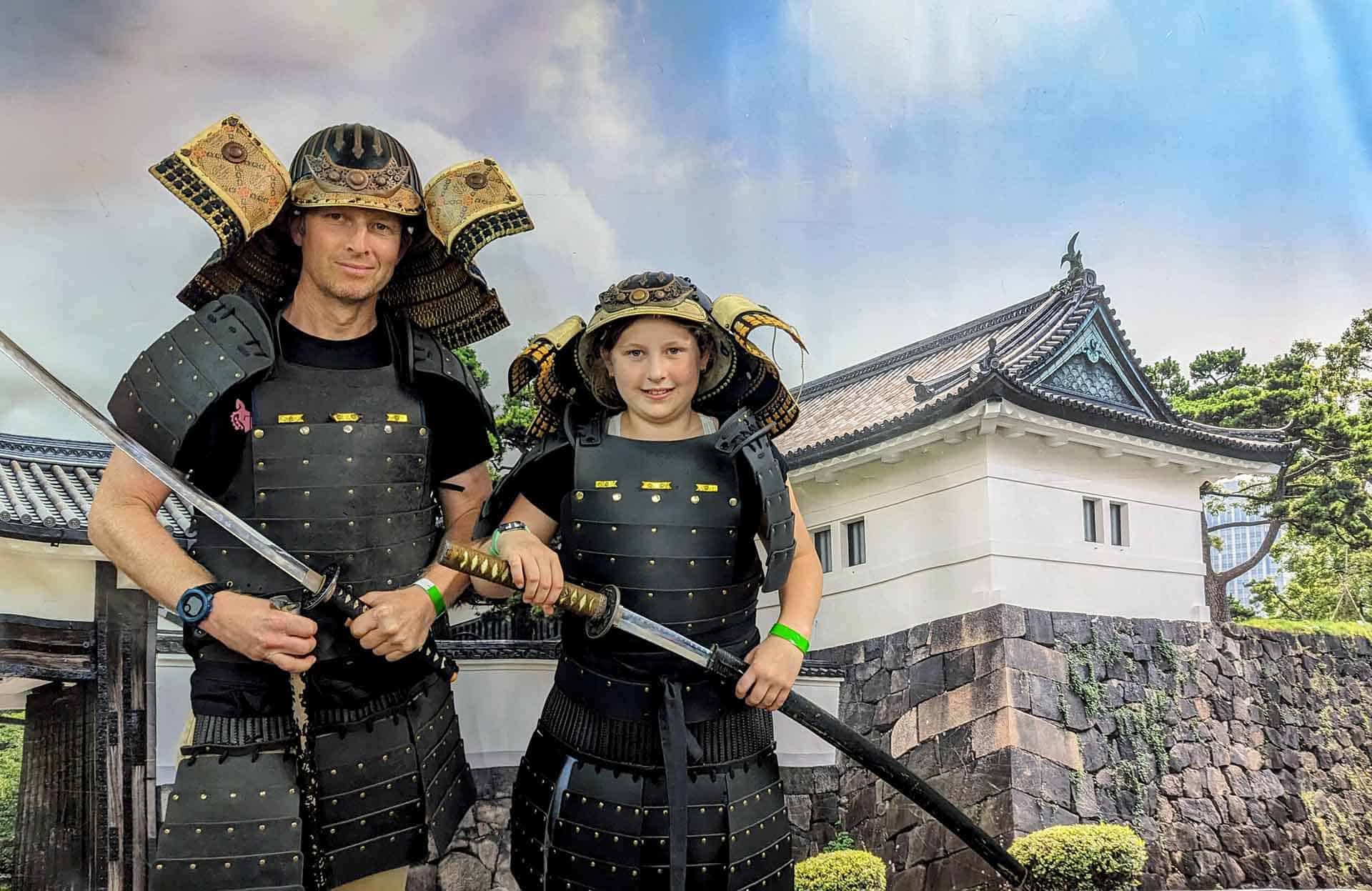
(and sorry the image above is me, Sam, and my daughter Annie in Kyoto at the Samurai museum!)
Who Were the Samurai?
They didn’t start as aristocrats. They started as hired muscle.
During the Heian period (794-1185), regional landowners began arming retainers to protect their estates as the imperial court’s grip on the provinces loosened – men who served, fought, and were paid for it. That’s really all samurai means: “those who serve.” Nothing noble about it yet.
Then, in 1180, two rival clans – the Taira and the Minamoto – went to war for Japan itself. Five years of fighting, known to history as the Genpei War, ended in 1185 with a decisive Minamoto victory. Minamoto no Yoritomo didn’t hand power back to the emperor in Kyoto. He declared himself shōgun – “great general” – and set up a military government in the small coastal town of Kamakura, as far from the old court as he could reasonably get.
That’s the moment hired swords became Japan’s ruling class. For the next 683 years, more or less, they never gave it back.
Two Centuries Nobody Chose to Live Through
The Kamakura shogunate eventually gave way to the Ashikaga shogunate in 1336, and Japan spent the next two centuries fractured and at war with itself – the Sengoku Jidai, the Warring States period every samurai film is secretly about. Even in the middle of it, the old order didn’t vanish entirely: on Kyushu, the ancient Kora Tamataregu Shrine – already eight centuries old by then – was receiving prayers from Prince Kaneyoshi, a son of Emperor Go-Daigo who held the title of shōgun for the breakaway Southern Court. Nobody’s authority meant much in this period. Everybody still wanted a shōgun’s blessing anyway.
It took three men, one after another, to end the chaos. Oda Nobunaga began the unification by force in the 1560s and ’70s, ruling for a decade from a captured mountain fortress in Mino Province he renamed Gifu. Toyotomi Hideyoshi finished the military conquest after Nobunaga’s assassination, and in 1583 raised Osaka Castle as the physical symbol of his new power – a building so associated with him that a rival lord building a castle of his own, decades later, painted its exterior black in open homage. And Tokugawa Ieyasu, after crushing the last serious opposition on a foggy October morning in 1600, at a crossroads called Sekigahara, took the title of shōgun in 1603 and made sure no one would ever need to reunify Japan again. That field is still there, and it’s on the road.
The Shogun’s Real Masterstroke Wasn’t a Battle – It Was a Road
This is the part of the story most “samurai history” content skips straight past. And it’s the part that actually explains the route you’ll ride on a shogun cycling tour.
Two years before he officially became shōgun, Ieyasu ordered the construction of five major highways radiating out from his new capital at Edo, modern Tokyo. The Gokaidō – the Five Highways – were built for one blunt purpose: rapid military deployment. If a distant daimyō rose in rebellion, Ieyasu wanted roads good enough to move troops fast enough to end it before it spread.
The most important of the five ran between Edo and the old imperial capital of Kyoto. The Nakasendō – the “inner mountain road” – cut straight through the middle of Honshu, 526 kilometres and 69 post stations, climbing through mountain pass after mountain pass, used in its day by daimyō processions, peasants, traders, and religious pilgrims alike. Twenty-six of those 69 post towns still stand in Nagano Prefecture today, largely as they looked in their heyday – which is exactly the ground a Fukuoka-to-Fuji route rides through in its final week.
Sankin-Kōtai: The System That Built a Road Network
If the Gokaidō were built for war, they were kept alive by something closer to house arrest.
In 1635, the third Tokugawa shōgun, Iemitsu, formalised a system called sankin-kōtai – alternate attendance. Every daimyō in Japan was required to divide his time between his home domain and Edo, travelling back and forth on a fixed schedule, while his wife and heir stayed permanently in the capital. Hostages, in effect, against rebellion. Powerful clans travelled with processions of thousands, and night travel was restricted, forcing every one of them to stop and pay for lodging at set intervals along the way – a deliberate financial bleed, designed to keep regional lords too poor to ever fund an army again.
Nowhere proves how tightly the shogunate ran this system better than Takayama. The compound known as Takayama Jinya dates back to 1615, and once Edo took direct control of Hida Province in 1692 it became the shogunate’s own administrative headquarters there – the local seat of a government that ran Japan from 1600 to 1868. Rice was collected as tax and stored in the granary that still stands on site. You can walk through the actual rooms where that business was conducted, under a roof that, in its present form, dates to 1816.
Bushido: A Code Built for a Country That Ran Out of Wars
Once Ieyasu’s peace held, Japan had a problem it hadn’t faced in generations – an entire hereditary warrior class with no wars left to fight. The samurai didn’t vanish. They were repurposed: bureaucrats, tax collectors, provincial administrators, still armed, still ranked, increasingly desk-bound.
It’s in this long Edo peace that bushidō – the way of the warrior – was formalised into the moral code most people now associate with the samurai. Drawing as much on Buddhist detachment and Confucian duty as on martial tradition, it prized loyalty above self-interest, frugality, honesty, and a sense of personal honour bound up inseparably with the sword at a samurai’s hip. A code largely written by men who’d stopped fighting. Which is part of why it reads like philosophy, not a battlefield manual.
From Sword to Sunset
The system Ieyasu built outlasted most empires. It took an American naval officer to crack it.
Commodore Matthew Perry’s arrival in 1853, forcing Japan open to foreign trade at gunpoint, destabilised a shogunate that had staked its entire legitimacy on keeping the outside world out. Fifteen years of crisis followed. In 1868, the Meiji Restoration handed power back to the emperor. By 1871, feudalism was abolished outright and samurai were forbidden from wearing swords outside military service. In 1876, their hereditary stipends were converted into government bonds – closing the books, quietly, on a warrior class that had run Japan since 1185.
Riding the Shogun’s Road Today
So this is the country the shogun cycling tour actually moves through – not a theme-park version of “old Japan,” but a landscape still legibly shaped by one shōgun’s road-building and two and a half centuries of enforced processions after him. We didn’t have to invent a route to match the theme. We just had to follow where the history already was.
From Fukuoka, the road runs south through Kyushu before crossing to Shikoku and Matsuyama, where the original wooden keep of Matsuyama Castle still holds a genuine collection of samurai weapons and armour – and a shrine on the hill above it, dedicated to the Tokugawa family, looks straight back down at it. From Osaka the route climbs to Kōyasan, the mountaintop headquarters of Shingon Buddhism founded by the monk Kūkai in 826, before Nara and Kyoto, where Tokugawa Ieyasu himself built Nijō Castle as his residence whenever business brought him to the old capital.
Then the history sharpens. Between Lake Biwa and Gifu the route stops at the Sekigahara Battlefield Memorial itself – whether you know the ground from Musashi, Shōgun, or Seven Samurai, this is the actual field where, on that foggy October morning in 1600, as many as 160,000 men decided who would run Japan for the next two hundred and fifty years. From there it’s on to Gifu, the town Nobunaga renamed and ruled from for a decade; the UNESCO-listed thatched roofs of Shirakawa-go; Takayama and its intact shogunate magistrate’s office; the old Nakasendō itself through the Kiso Valley; and Matsumoto, where the black-walled “Crow Castle” – one of only twelve original castles left standing in Japan – was once guarded by ninja of the Akutagawa family before the road finally climbs toward Fuji, the mountain Edo-period commoners of the Fuji-kō sect made their own pilgrimage to on foot.
That’s the difference between reading about samurai history and cycling through it. Sekigahara isn’t a plaque you read about from a bus window. It’s a field you ride past under your own power, on the same ground where the roads, the hostages, the processions, and the code all trace back to a single foggy morning.
See the full route: Bike Odyssey’s Shōgun cycling tour traces this history across 27 days and 1,744 km, from Fukuoka through Matsuyama, Kyoto, Sekigahara, Gifu, Takayama, and the Nakasendō’s Kiso Valley to Mount Fuji.