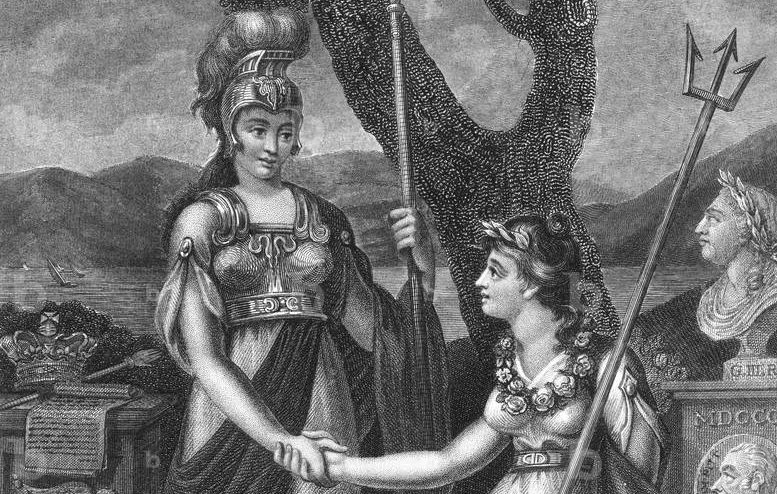
The name predates nations, borders, and the complications of history. Britannia was the Roman name for the islands they encountered at the edge of their known world – but even they were borrowing. The Greeks knew these islands centuries earlier as Pretania – likely derived from the ancient Celtic name the inhabitants used for themselves. It is perhaps the oldest recorded name for this place, and it belongs to no flag.
was a geographical expression, not a political one. It described land, coastline, and the people who had lived here for millennia before any empire arrived to name them.
The British Isles is older still as a concept – an archipelago sitting at the northwest edge of Europe, shaped by the same ancient seas, the same Atlantic weather, the same deep geological story. The people who settled these islands – Celtic, Pictish, Gaelic, Brythonic – moved freely across the water long before anyone thought to draw lines on a map. Ireland and Britain were not separate worlds. They were neighbours who shared language roots, mythology, burial traditions, and blood.
The Romans did something else with the name, too. They made her a person. Britannia appeared on Roman coins as early as the first century AD – a goddess, helmeted and seated, holding a spear and shield, the ocean at her feet. She was the embodiment of the islands themselves – unconquered in spirit even when occupied (The Roman’s showed her sitting to personify this subjection). It was a remarkable thing to do with a place name but something did often – Gallia – Gaul (modern France), frequently depicted, sometimes mourning after conquest, Germania – represented as a fierce, untamed woman, often shown captured or resistant, Africa – one of the most common, shown with an elephant headdress.
Importantly, she was never just England. She was never just modern Britain. The Romans knew Ireland too, they called it Hibernia. They understood it as part of the same archipelago, the same world at the edge of everything. Their geographers wrote about it. Their traders reached it. Britannia as a concept encompassed all of these islands, Ireland included. The idea that the name belongs exclusively to one modern nation is a much later invention, and a much smaller one. When Rome looked north and personified what they found, they were imagining the whole archipelago.
There is also something telling in the fact that Rome never fully conquered even Britain itself. Scotland – Caledonia – resisted, which is partly why Hadrian built his wall across the north of England. Britannia was always an aspiration. She represented what Rome imagined these islands to be as much as what they actually controlled. She was a dream of a place as much as the place itself and in that sense she belonged to everyone here, including those who were never conquered at all.
Later empires would borrow her image and bend it to their own purposes. But the original idea was simpler and stranger – that these islands had a soul, and that soul had a face, and that face looked out over all of them equally.
Our route travels through all five countries of these islands – England, Wales, Ireland, Northern Ireland and Scotland. Each is distinct. Each has its own language, its own character, its own hard-won identity. The tensions between them are real, and in places the wounds are not old. We don’t pretend otherwise.
But we chose the name Britannia because it reaches back past all of that, to a time when these islands were simply islands, and the people on them were simply people. The Greeks looked out across the known world and found Pretania at its edge. The Romans followed, called it Britannia, and gave it a face. In that ancient sense, the name has always belonged to everyone who lives here, not to any one nation, government, or century that later tried to claim it.
That history is never far away on this ride. You will pass through landscapes that were ancient before the first written word, along roads the Romans cut, past monuments that predate every country whose border you will cross. Travelling slowly, by bicycle, through all five countries gives you the time and the stillness to actually consider it and to ask who came before, what they built, what they believed, and what became of them. The name Britannia is an invitation to think about all of that.