Blog

  • Day 16, June 25, 2026 – Rest Day in Ypres

    Day 16, June 25, 2026 – Rest Day in Ypres

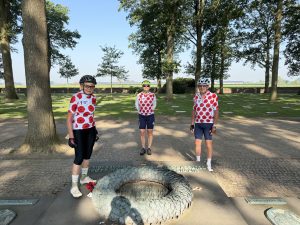
    Although an optional 35-mile ride was possible for today, I chose to go only on a 10-mile ride to a cemetery and back. That gave me time to catch up on my blogs because I was behind three days.

    Going such a short distance also enabled me to take a nap after my ride. With my room around 90 degrees last night, I did not sleep well. It has gotten even warmer today, with the temperature reaching 100 degrees this afternoon.

    This afternoon, though, I walked to the In Flanders Fields Museum which tells the historic story of the First World War in the West Flemish front region. It narrates the invasion of Belgium and the first months of the war of movements, and the subsequent four years of trench warfare in the Westhoek, from the beach of Nieuwpoort to the Lys.
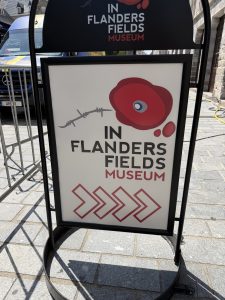
    The extensive information about the battles in the Flanders area of Belgium was very informative and actually quite depressing. So many young men were mowed down in the Great War in prime of their lives. In some ways, it was reminiscent of the Vietnam War. Very little was gained for the thousands of young men who valiantly and needlessly died in both wars.

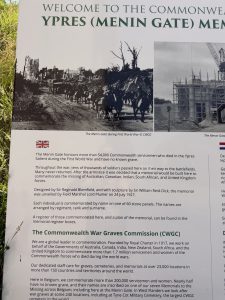
    This afternoon, I walked to the Menin Gate. Between October 1914 and September 1918 hundreds of thousands of servicemen of the British Empire marched through the town of Ypres’s Menin Gate on their way to the battlefields. The memorial now stands as a reminder of those who died who have no known grave and is perhaps one of the most well-known war memorials in the world.
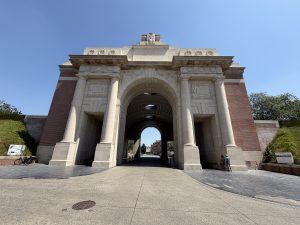
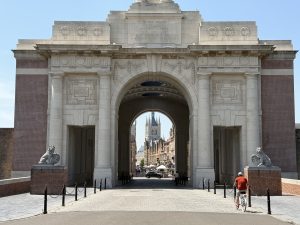
    The gate bears the names of more than 54,000 soldiers who died in Belgium and have no known grave. This evening, I attended the Last Post Ceremony at 8.00 p.m. It honors those 54,000 men. In addition, people who have some attachment to the Great War can participate. Of our riders, Ian had a great uncle and Dawn had a grandfather who fought in the area. It was a touching ceremony.
    As I write this blog in my hotel room at 9:05 p.m., my time, my phone won’t charge. The screen says, “Charging on Hold—Charging will resume when iPhone returns to normal temperature.” Tomorrow, the forecast is for the temperature to reach as high as 104 degrees. Fortunately, the route will not have a lot of elevation gain. However, we have to ride over lots of Belgian cobblestones. Stay tuned.
  • June 24, 2026, Day 15 – Lens to Ypres – 37 hot miles

    June 24, 2026, Day 15 – Lens to Ypres – 37 hot miles

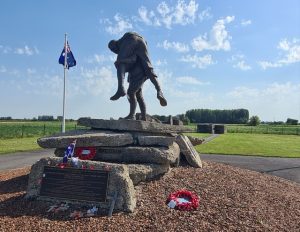
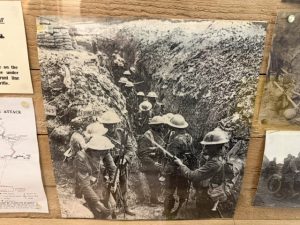
    Today, we crossed the border into Belgium! Our first stop in Belgium was the village of Fromelles which was the site of the famous battle where the First Australian Imperial Force saw action on the Western Front. It is still considered the “worst 24 hours in Australia’s entire history” with thousands of British and Australian casualties.

    The Battle of Fromelles took place on 19 and 20 July 1916, between British and Australian divisions and a Bavarian division. It was a fierce confrontation, with nearly 8,500 victims in less than 24 hours. The bodies of many of those killed on the battlefield were never found.

    In France, the drivers were very courteous. They routinely stopped to allow us bicyclists to cross the road, even in roundabouts which were plentiful. Not so in Belgium. The drivers are not rude, but they also are not accommodating to bicyclists. As usual, we must be constantly vigilant at intersections.

    Another big difference is the language. In France, I could typically read road signs and even speak a little French if I had to. I don’t know how people learn to speak or spell in Flemish. For example, we are staying in Ypres. How would you pronounce that? I will tell you later in this blog.

    Another difference is cobblestone streets. The people of Belgium are very into cycling. Yet they have cobblestone streets within their cities—at least in Ypres. Those streets are very unfriendly to cyclists.

    Like France, though, we are often on very quiet roads used mostly by farmers. Their huge tractors take up all but inches of the road. When I see them coming, I just get off the road because their wheels are taller than me and I don’t want to take any chances. The roads here are a bit flatter than France’s roads.

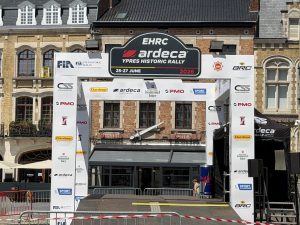
    Ypres is hosting some type of Grand Prix car rally this week. There are sleek cars everywhere and apparently all the hotel rooms are filled up. No one anticipated this being such a hot week and our hotel for two nights does not have air conditioning. It is so hot that I left a chocolate bar on the table in my room and it melted into a blob. (I put it in my refrigerator to let it regain its shape and it still tasted good).

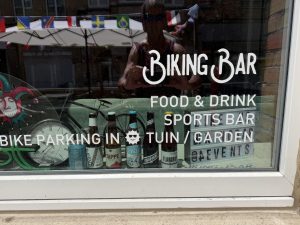
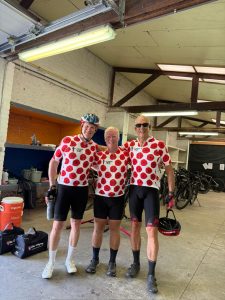
    Rather than show you more pictures of cemeteries (which are plentiful around here), I will share a human-interest story with you. Tonight we went to a Bike Bar before dinner for our briefing which occurs every day, explaining the highlights of the next day’s ride. The bar is owned by Kurt Titeca, apparently a well-known Belgian racer. In it, he sells bicycling jerseys with poppies on them and an inscription “1914-18 Remembered, Make Peace not War.”

    The jerseys are nice, but they look somewhat feminine and I don’t need any more jerseys. But some of my fellow riders bought them and wearing them makes them quite visible.

    Ypres is pronounced  “e per.”

  • Day 14, June 23, 2026 Bapaume to Lens

    Day 14, June 23, 2026 Bapaume to Lens – 40 miles, 1500’

    Today began with a half-hour shuttle to the Commonwealth War Graves Commission Experience in Beaurains. Previously, I mentioned that most small towns had a church with a graveyard adjacent to it and statues to honor the dead from the Great War and WWII.

    Unknown to me until today, the Commonwealth War Graves Commission maintains war cemeteries throughout the world. We were taken on a tour to see the work that is needed to commemorate the Commonwealth casualties from the First and Second World Wars. This organization works to recover and rebury the dead as they are continually found throughout the world. Many people make headstones, others maintain grounds, etc.

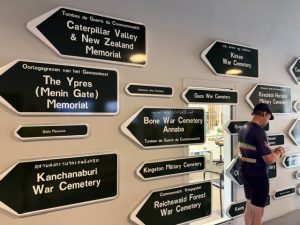
    In Belgium alone, the CWGC commemorates more than 200,000 servicemen. More than half have no known grave, and in just Belgium, they maintain 240 cemeteries—which is indicative of the fighting throughout the country. This picture is a sample of the many signs they make for cemeteries throughout the world:

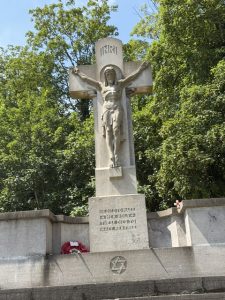
    As we biked, we regularly saw impressive war monuments and memorials along the Western Front.

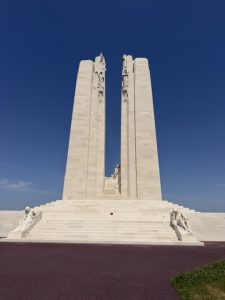
    Most notable was the Canadian National Vimy Memorial at Vimy Ridge. Vimy Ridge is sacred ground to the Dominion of Canada. Here, at the height of the ridge on Hill 145, stands the Canadian National Vimy Memorial with its great twin pylons rising up into the sky. Around the memorial are twenty sculptured figures representing such ideas as peace, justice, mourning and grief. Like the Australian National Memorial at Villers-Bretonneux, Vimy carries the names of Canada’s ‘missing’ soldiers, those with ‘no known grave’ who died in France between 1914 and 1918.

    The Canadian memorial is situated in a 100 acre park given by the people of France to Canada as a tribute to the Canadian soldiers who fought and died on the Western Front beside their French allies. Significantly, the park is part of the battlefield of the Battle of Vimy Ridge, fought between 9 and 12 April 1917. During those days, the Canadians seized the ridge from the Germans and drove the enemy back down from the heights. It was a significant victory, for British and French forces had failed to drive back the Germans in this area despite strong offensives in 1915.

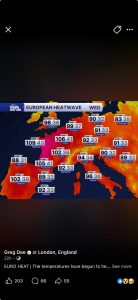
    Another significant event today was the weather. It was HOT! France is experiencing its hottest weather on record. We are drinking lots of water with electrolytes.

  • June 22, 2026, Day 13 Amiens to Bapaume, 47 miles

    June 22, 2026, Day 13 Amiens to Bapaume, 47 miles, 2200’ of elevation gain

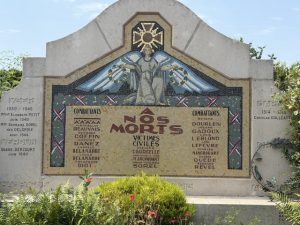
    We left Amiens on bike paths along the river Somme, passing small villages through the regions where many battles of the WWI took place. Most towns had a memorial to soldiers from the community who died during the Great War. And, what I found interesting is that many towns also had memorials to the ordinary citizens who died during the war either due to the treachery of the Germans or Allied warfare associated with routing the Germans from those communities.

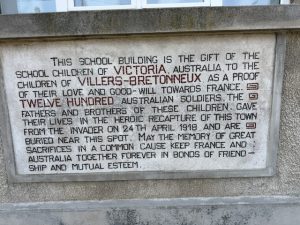
    One of the first villages we stopped at was Villers Bretonneux which is considered an Aussie village “ad honorem” as the city of Melbourne sponsored the reconstruction of the village after the first and second battles in 1918.

    We stopped outside of a school which had been reconstructed after the Great War due to the generosity of people from Victoria, Australia, including children who raised funds to construct a new school. As luck would have it, I stopped there with a fellow rider from Australia. He told me about the catastrophic fires in Melbourne in 1969 which destroyed much property including an elementary school.

    When that happened, the citizens of Villers Bretonneux, including school children, returned the favor from a generation ago by raising money to build a new elementary school in Victoria. Bad news is what typically makes news. But I was impressed with the kindness and generosity of citizens from both communities toward each other.

    See this very moving plaque on the wall of Villers Bretonneux school:

    Throughout the ride before lunch, we saw many public buildings such as townhalls, which had Australian signs and drawings because Australian trooper fought extensively in this area to free these villages from German occupation. The villages of Corbie, Pozières and Longueval had many memorials and monuments dedicated to the Commonwealth soldiers who died in the area, particularly British, Australians and New Zealanders.

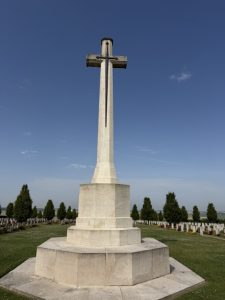
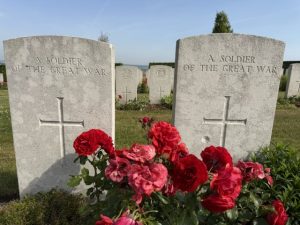
    We stopped in Pozières for a guided tour of a big British cemetery and a memorial for the First Australian division. It was quite moving to see this huge cemetery, and it was particularly moving for fellow riders from Canada and Australia.


    We had lunch in the key village for the battle of the Somme—Albert. The Battle of the Somme, fought over five months during 1916, was one of the bloodiest battles of World War I. After lunch, I toured the Battle of the Somme museum which described the incredible suffering of soldiers involved in that war. Set in medieval tunnels, it included a re-creation of the trenches and a first aid post, as well as photos, memorabilia, videos, and posed models.

    During that battle, men lived in trenches, under constant bombardment, with dead decomposing bodies all around them, in mud which caused trench feet, rats the size of small rabbits, and mustard gas. Those horrible conditions did not produce much except for an incredible number of deaths. “Progress” was measured in meters and deaths in the hundreds of thousands.

    I will leave it to you to read more about the Battle of the Somme. Be prepared for gruesomeness. Wikipedia summarizes it well, “The battle involved more than three million soldiers, with over one million killed or wounded, making it one of the deadliest battles in human history.”

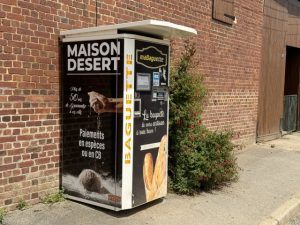
    On a much lighter note, as I was riding through a village later in the day, I came across a bread vending machine. It was labeled “Maison desert” and contained baguettes. In my travels in Europe, I have observed a significant affinity for bread products. Bread doesn’t appeal to me and I surely would not call it dessert.

    Baguettes are tough. A couple of weeks ago, I was riding with a fellow rider from Oregon who stopped at a roadside baguette stand. As he bit into his baguette, he broke a tooth off. No baguette desserts for me:

  • June 20 and 26, Days 11 and 12 Forges to Amiens and a rest day

    June 20, 2026, Day 11 – Forges to Amiens – 50 miles, 1700’ gain and Day 12-June 21, a rest day.

    Today’s ride was ordinary by recent standards—it was characterized by quiet, narrow roads with little traffic, small villages with churches with rooster weathervanes, statues honoring soldiers who died in war, and crucifixes on corners. All in all, it was another pleasant ride except for getting into the big city of Amiens where we are staying for two nights, since tomorrow is a rest day.

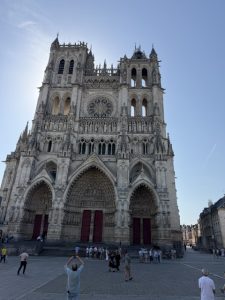
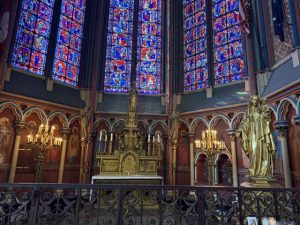
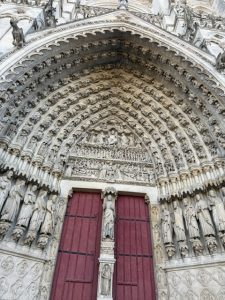
    Amiens is quite an impressive city. Among its most notable attractions is the Cathédrale Notre-Dame d’Amiens, France’s largest Gothic cathedral and a UNESCO World Heritage site. It has an immense nave volume (larger than Notre-Dame de Paris) a sculpted west façade known as the “Bible in stone” and a filled choir and carved stalls.

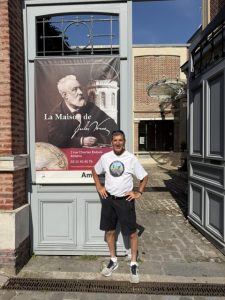
    Early in the tour, I took a picture of Jule Verne’s birthplace. But he actually spent most of his adult life in Amiens for 34 years (1871-1905). His house was small but opulent. Had I not had a day to spend in Amiens, I would not have gone out of my way to see it. But I had time of my hands, so I did.

    The real jewel of Amiens though is the Notre Dame cathedral. It is amazingly huge and ornate. My pictures don’t do it justice. If you want to see some incredible pictures of it and read about its history, go to www.cathedrale-amiens.fr   

  • Day 10, June 19, 2026, Rouen to Forges

    ,

    Rouen to Forges, 31 miles, 1900 feet of elevation gain

    Rouen is also the site where the young French heroine Joan of Arc (Jeanne d’Arc) was tried for heresy and burned at the stake in the central square in 1431.

    Here is what today’s guide says about her. “Joan of Arc was not just a hero, but a martyr and eventually named as a patron saint to a whole country, and so much of it happened here in Rouen.

    Joan of Arc was tied to a stake and burnt to death on May 30, 1431, when she was just nineteen years old. It was only a year earlier that she had been captured by the English she had been fighting against, and only a year before that when she had begun her military campaign against them. She was fighting on behalf of the son of the dead French King Charles VI, who had had his throne stolen from him. The English who were controlling parts of French territory wanted to make an example of her and her execution happened in the Old Market Square of Rouen.

    Although she was killed by the English authorities with the support of the Catholic Church, their decision was overturned just a generation later. Joan’s mother got permission from the Pope in 1455 to have the guilty verdict that condemned her re-examined and a year later she was ‘rehabilitated’.”

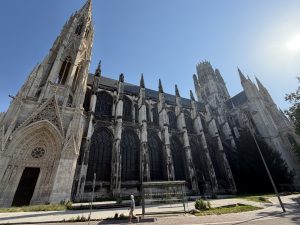
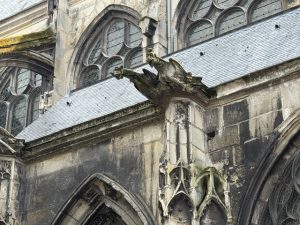
    Rouen is also filled with cathedrals with numerous spires on them. I took some pictures of them on the way out of this busy city this morning.

    Once we got out of the city of Rouen, the ride became increasingly more pleasant despite some long hills and temperatures steadily reaching uncomfortably hot in the early afternoon.

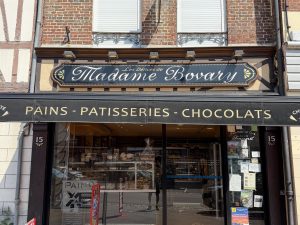
    Early in our 30-mile journey today, we passed through the village of Ry, a village everybody in France knows and associates with Yonville-l’Abbaye, the village Gustave Flaubert invented for his book “Madame Bovary.” I think I read that book as a first-semester freshman in college and my brother, Fred, talked me into taking French 460—French masterpieces in English translation because it fit our schedule of only going to classes on Tuesdays and Thursdays.

    That class required reading a book every week by a French author. I really can’t recall if I read the book or not but I do recognize a bakery when I see one. Madame Bovary’s bakery had a wide selection of tasty goods.

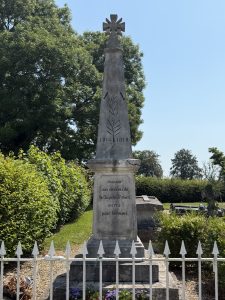
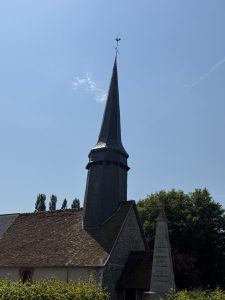
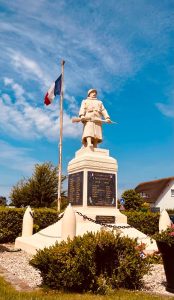
    As we biked on quiet roads through peaceful villages, I noticed two things that I had noticed before. First, almost every little town that we passed through, showed a lot of respect for the men from their town who had died in wars. In almost every town, there was a lovely stone church with a rooster on top of a weathervane (more on that later).

    In front of the church was often a graveyard with a statue in it or simply a statue that listed the men who had died in the Great War 1914-1918 and also in WWII.

    As I passed by countless churches and public buildings, I wondered why there was a weathervane with a rooster on top of it. So, I looked it up when I got back to my hotel. Here is the answer I got from the internet:

    “It is associated with vigilance and watchfulness, inspired by the biblical story in which Peter denies Jesus three times before the rooster crows, reminding Christians to remain alert and faithful. The rooster’s crowing at dawn also symbolized the triumph of light over darkness and good over evil, reinforcing its moral and spiritual connotations. French kings adopted the rooster as a symbol of courage, determination, and virility, reflecting the qualities of the Gauls.

    In summary, the rooster symbolizes France through a combination of linguistic heritage, Christian moral symbolism, and historical adoption by French rulers, making it a lasting emblem of national identity and cultural pride.”

    Since it was about 90 degrees when I finished lunch, I opted not to ride the optional 21-mile loop.

  • June 18, Day 9 – Honfleur to Rouen, 57miles

    After leaving the harbor town of Honfleur we biked across bumpy cobblestones before hitting the Normandy countryside again. Soon we entered a regional natural park called the “boucles de la Seine Normande”, which is little inhabited and where people traditionally farm. Again, the ride was often on secondary roads, with little traffic and hamlets scattered along the way. In fact, there were several times when a huge tractor was heading for me. I wisely simply got off the road to let them pass by. Otherwise, they would have passed me by inches.

    In many of the little villages we passed through, their was a beautiful stone church, often with a cemetery in front of it and a statue commemorating the young men from that town who died in WWI and WWII.

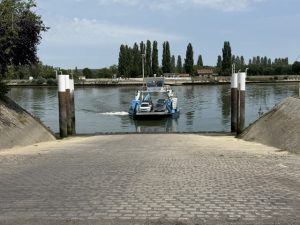
    In the village of La Bouille, we encountered the most unique aspect of the day–taking a bike ferry across the Seine River (the same river that flows through Paris). It was about a 5-minute, easy, ride to our lunch spot on the other side.

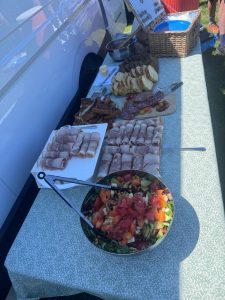
    Our guides, Heinrich, Sean, Collie, and Christiana, do an excellent job with lunch every day. Salad is a staple, which I don’t like. But there are enough other options to please my fussy palate.

    Every morning, we stop for “tea” as our guides say. The stop actually has nothing to do with tea. Rather it is the term used by our guides (who are mostly from New Zealand and Ireland to describe a morning break. Instead of tea, we fill up on water and the guides often get snacks from nearby boulangeries, which seem to be in every little town.

    Like Honfleur the day before, getting into the city center of Rouen was very vexing. Although I am using both a Hammerhead with pre-programmed routes as well as Ride with GPS, I managed to get lost both days as I got into the maze of streets in the cities. So, to cure my disorientation, I simply put the hotel into google maps and eventually found my way.

    The city of Rouen has endured a turbulent history. It was devastated by fire and plague several times during the Middle Ages and was occupied by the English during the Hundred Years War. Later, it was extensively bombed by the Allies in the second World War. Nonetheless, it still has lots of impressive architecture.

  • June 15, and June 16 2026, Bayeux to Putot-en-Auge, 42 miles and Putot-en-Auge to Honfleur, 30 miles

    I am combining both these days because they were very similar in terms of riding. The roads were predominantly narrow, scenic, and with little traffic.

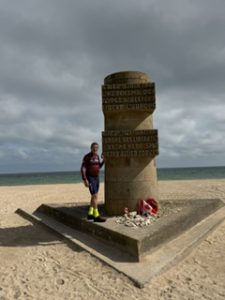
    These rides brought us further along the Normandy coast. One of the highlights was biking by Juno and Sword beaches where the Canadian militia landed on D-Day. One of the women on the tour had a father who landed at Juno beach on D-Day, so stopping there was especially significant for her. Even though I did not have such a personal experience, the museum at Juno Beach was very informative and well worth the stop.

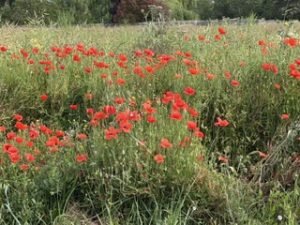
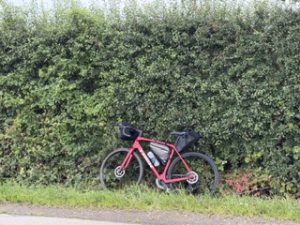
    The riding was characterized by field after field of brown wheat or green corn, often peppered with red poppies, all against the blue backdrop of the ocean. Often, the roads were little wider than a farm tractor—very scenic. Another characteristic of the roads is that they were typically boxed in by dense hedgerows. Seeing them caused me continually think about the difficulty and bravery of soldiers who had to fight through them.

    We had lunch adjacent to the Pegasus Bridge. After lunch, I toured the Pegasus Memorial Museum which chronicled the bravery of British gliders and paratroopers, (after whom the bridge is named) as they endured fierce fighting to take that bridge. In contrast to the Normandie and Juno museums, there was so much that I did not know about the battle for the Pegasus bridge that I could have spent 5 hours there, learning all about it. I didn’t. I just spent about a half hour and got on my way.


  • Day 6, June 14, 2026: Rest day and tour of Normandy Battle Sites

    Day 6, June 14, 2026: Rest day and tour of Normandy Battle Sites

    Today was a rest day, so did not bicycle. But we were not idle. Rather than bicycling, our leaders brought us (by taxi) to three historic sites.

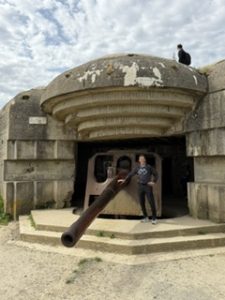
    The first site was the German batteries at Longues-sur-mer.  A little background is in order here to explain the significance of this site. Germany invaded France in May of 1940. D-Day was June 6 of 1944. Starting in 1942 Germany began preparing what they called the “Atlantic Wall.” The “wall” was a line of fortifications along the Atlantic coast from Norway to Spain to defend Germany from attacks from the United Kingdom.

    Although the Germans expected an invasion at Calais, France, the nearest point to England, they also fortified the Normandy Beach area. In the particular spot we visited, the Germans had built four concrete “pill boxes” with cannons overlooking the Atlantic. To make matters even tougher for the Allies, these pill boxes were on top of cliffs about 180’ above the seashore.

    We should all be greatly impressed at the bravery and courage of soldiers as they disembarked from ships into withering cannon and gunfire. Amazingly, highly trained rangers ascended these cliffs and overpowered the Germans in the pill boxes. By the end of the day on June 6, 1944, the Allies were on top of the cliffs at Normandy.

    Next, we went to the Bayeux War Cemetery. It was an American Cemetery, the largest cemetery in France. It contains 4,144 Americans who sacrificed their lives—just at that particular invasion site. It was a sad and sobering site.

    After returning to our hotel, I walked about a mile to the Normandie Memorial Museum of the Battle of Normandy—a museum exclusively devoted to the Battle of Normandy and the Allies journey to the Rhine throughout the summer of 1944. It was a very informative museum, well-worth the visit.

    Even though it was a quiet, down-day, I still walked about 12,000 steps and I am ready for the ride tomorrow to more Normandy invasion sites.

  • Day 5: June 14, 2026: Canisy to Bayeux

    Today was a very pleasant day. There were a few climbs but nothing very difficult. Most of the ride was characterized by riding on narrow, quiet roads surrounded by hedgerows.

    The hedgerows are extremely dense. I’ve read about the difficulty of Allied troops getting through them and the deadly benefit they provided to German troops who were often shielded by them. The bravery of the Allied troops who risked their lives (and often sacrificed lives) to free France was incredible.

    As we got closer to Bayeux, our destination for the day and one of the sites of the Allied invasion, we often saw monuments and flags by the side of the road in recognition of the Allies’ sacrifice and bravery. One of the more poignant moments of the day was a monument to the American 29th Infantry Division that fought in the Cerisy area that we were passing through.

    In 2024, a number of plaques were mounted on a long stone wall constructed for the purpose of recognizing men who lost their lives in the area. One of the plaques stated, “ In the fierce combat between D-Day 1944 and V.E. Day, 1945 the Division had 20,400 casualties, 50% of these in Normandy…”

    After seeing that memorial I went into the Abbey de Cerisy-la-Foret which was built starting in 1030. In contrast to the ruined abbey I saw a few days ago, this very impressive abbey is fully intact. Soaring arches, worn marble floors was thousands of footsteps over the last 1000+ years, and magnificent architecture made this very impressive to say the least. If you want to learn more about it, see www.abbaye-cerisy.fr.

    The end of our easy 40-mile ride brought us to Bayeux, a historic city, in part because of the Allied invasion at its seashore. It is also impressive because of the Bayeux cathedral, a remarkably preserved Norman jewel of medieval architecture. I took a number of pictures of it because it is so stunning. If you want to know more about it, see www.bayeux.fr/fr/decouvrir-bayeux/cathedrale-notre-dame .

    I was looking forward to seeing the Bayeux Tapestry, but it is currently in London, while the Bayeux Cathedral museum is being repaired. The tapestry is an embroidered cloth nearly 230 feet long and 20 inches tall that depicts the events leading up to the Norman Conquest of England in 1066, led by William, Duke of Normandy, challenging Harold II, King of England, and culminating in the Battle of Hastings. It is thought to date to the 11th century, within a few years of the battle.  See more at Bayeux Tapestry – Wikipedia.