June 22, 2026, Day 13 Amiens to Bapaume, 47 miles, 2200’ of elevation gain
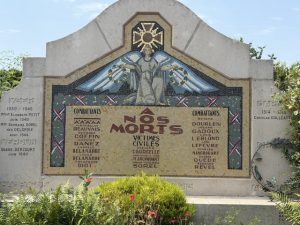
We left Amiens on bike paths along the river Somme, passing small villages through the regions where many battles of the WWI took place. Most towns had a memorial to soldiers from the community who died during the Great War. And, what I found interesting is that many towns also had memorials to the ordinary citizens who died during the war either due to the treachery of the Germans or Allied warfare associated with routing the Germans from those communities.
One of the first villages we stopped at was Villers Bretonneux which is considered an Aussie village “ad honorem” as the city of Melbourne sponsored the reconstruction of the village after the first and second battles in 1918.
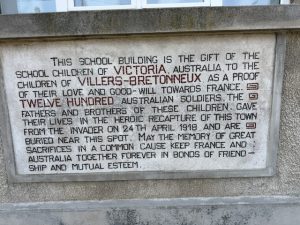
We stopped outside of a school which had been reconstructed after the Great War due to the generosity of people from Victoria, Australia, including children who raised funds to construct a new school. As luck would have it, I stopped there with a fellow rider from Australia. He told me about the catastrophic fires in Melbourne in 1969 which destroyed much property including an elementary school.
When that happened, the citizens of Villers Bretonneux, including school children, returned the favor from a generation ago by raising money to build a new elementary school in Victoria. Bad news is what typically makes news. But I was impressed with the kindness and generosity of citizens from both communities toward each other.
See this very moving plaque on the wall of Villers Bretonneux school:
Throughout the ride before lunch, we saw many public buildings such as townhalls, which had Australian signs and drawings because Australian trooper fought extensively in this area to free these villages from German occupation. The villages of Corbie, Pozières and Longueval had many memorials and monuments dedicated to the Commonwealth soldiers who died in the area, particularly British, Australians and New Zealanders.
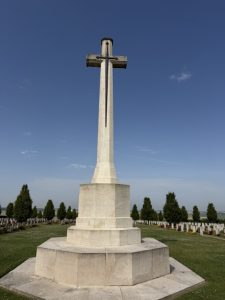
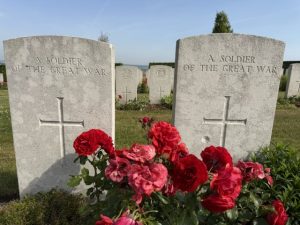
We stopped in Pozières for a guided tour of a big British cemetery and a memorial for the First Australian division. It was quite moving to see this huge cemetery, and it was particularly moving for fellow riders from Canada and Australia.
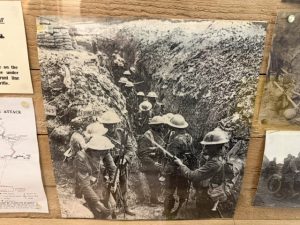
We had lunch in the key village for the battle of the Somme—Albert. The Battle of the Somme, fought over five months during 1916, was one of the bloodiest battles of World War I. After lunch, I toured the Battle of the Somme museum which described the incredible suffering of soldiers involved in that war. Set in medieval tunnels, it included a re-creation of the trenches and a first aid post, as well as photos, memorabilia, videos, and posed models.
During that battle, men lived in trenches, under constant bombardment, with dead decomposing bodies all around them, in mud which caused trench feet, rats the size of small rabbits, and mustard gas. Those horrible conditions did not produce much except for an incredible number of deaths. “Progress” was measured in meters and deaths in the hundreds of thousands.
I will leave it to you to read more about the Battle of the Somme. Be prepared for gruesomeness. Wikipedia summarizes it well, “The battle involved more than three million soldiers, with over one million killed or wounded, making it one of the deadliest battles in human history.”
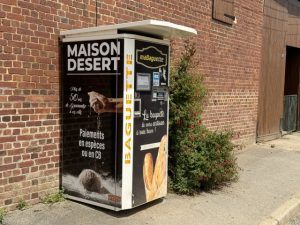
On a much lighter note, as I was riding through a village later in the day, I came across a bread vending machine. It was labeled “Maison desert” and contained baguettes. In my travels in Europe, I have observed a significant affinity for bread products. Bread doesn’t appeal to me and I surely would not call it dessert.
Baguettes are tough. A couple of weeks ago, I was riding with a fellow rider from Oregon who stopped at a roadside baguette stand. As he bit into his baguette, he broke a tooth off. No baguette desserts for me:
Leave a Reply