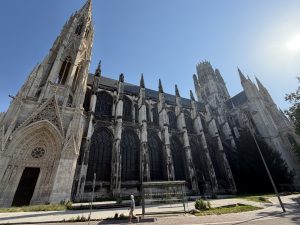
Rouen to Forges, 31 miles, 1900 feet of elevation gain
Rouen is also the site where the young French heroine Joan of Arc (Jeanne d’Arc) was tried for heresy and burned at the stake in the central square in 1431.
Here is what today’s guide says about her. “Joan of Arc was not just a hero, but a martyr and eventually named as a patron saint to a whole country, and so much of it happened here in Rouen.
Joan of Arc was tied to a stake and burnt to death on May 30, 1431, when she was just nineteen years old. It was only a year earlier that she had been captured by the English she had been fighting against, and only a year before that when she had begun her military campaign against them. She was fighting on behalf of the son of the dead French King Charles VI, who had had his throne stolen from him. The English who were controlling parts of French territory wanted to make an example of her and her execution happened in the Old Market Square of Rouen.
Although she was killed by the English authorities with the support of the Catholic Church, their decision was overturned just a generation later. Joan’s mother got permission from the Pope in 1455 to have the guilty verdict that condemned her re-examined and a year later she was ‘rehabilitated’.”
Rouen is also filled with cathedrals with numerous spires on them. I took some pictures of them on the way out of this busy city this morning.
Once we got out of the city of Rouen, the ride became increasingly more pleasant despite some long hills and temperatures steadily reaching uncomfortably hot in the early afternoon.
Early in our 30-mile journey today, we passed through the village of Ry, a village everybody in France knows and associates with Yonville-l’Abbaye, the village Gustave Flaubert invented for his book “Madame Bovary.” I think I read that book as a first-semester freshman in college and my brother, Fred, talked me into taking French 460—French masterpieces in English translation because it fit our schedule of only going to classes on Tuesdays and Thursdays.
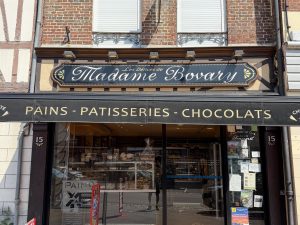
That class required reading a book every week by a French author. I really can’t recall if I read the book or not but I do recognize a bakery when I see one. Madame Bovary’s bakery had a wide selection of tasty goods.
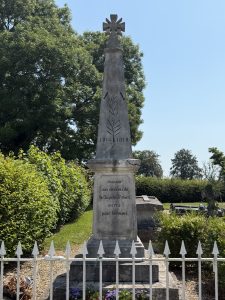
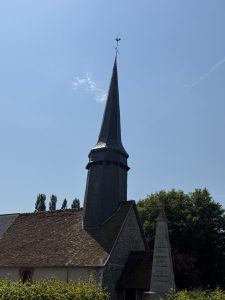
As we biked on quiet roads through peaceful villages, I noticed two things that I had noticed before. First, almost every little town that we passed through, showed a lot of respect for the men from their town who had died in wars. In almost every town, there was a lovely stone church with a rooster on top of a weathervane (more on that later).
In front of the church was often a graveyard with a statue in it or simply a statue that listed the men who had died in the Great War 1914-1918 and also in WWII.
As I passed by countless churches and public buildings, I wondered why there was a weathervane with a rooster on top of it. So, I looked it up when I got back to my hotel. Here is the answer I got from the internet:
“It is associated with vigilance and watchfulness, inspired by the biblical story in which Peter denies Jesus three times before the rooster crows, reminding Christians to remain alert and faithful. The rooster’s crowing at dawn also symbolized the triumph of light over darkness and good over evil, reinforcing its moral and spiritual connotations. French kings adopted the rooster as a symbol of courage, determination, and virility, reflecting the qualities of the Gauls.
In summary, the rooster symbolizes France through a combination of linguistic heritage, Christian moral symbolism, and historical adoption by French rulers, making it a lasting emblem of national identity and cultural pride.”
Since it was about 90 degrees when I finished lunch, I opted not to ride the optional 21-mile loop.
Leave a Reply