
After leaving the harbor town of Honfleur we biked across bumpy cobblestones before hitting the Normandy countryside again. Soon we entered a regional natural park called the “boucles de la Seine Normande”, which is little inhabited and where people traditionally farm. Again, the ride was often on secondary roads, with little traffic and hamlets scattered along the way. In fact, there were several times when a huge tractor was heading for me. I wisely simply got off the road to let them pass by. Otherwise, they would have passed me by inches.
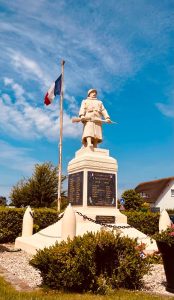
In many of the little villages we passed through, their was a beautiful stone church, often with a cemetery in front of it and a statue commemorating the young men from that town who died in WWI and WWII.
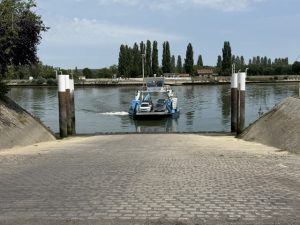
In the village of La Bouille, we encountered the most unique aspect of the day–taking a bike ferry across the Seine River (the same river that flows through Paris). It was about a 5-minute, easy, ride to our lunch spot on the other side.
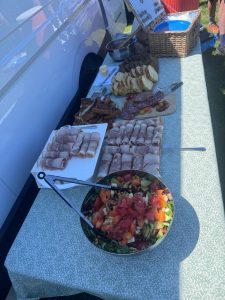
Our guides, Heinrich, Sean, Collie, and Christiana, do an excellent job with lunch every day. Salad is a staple, which I don’t like. But there are enough other options to please my fussy palate.
Every morning, we stop for “tea” as our guides say. The stop actually has nothing to do with tea. Rather it is the term used by our guides (who are mostly from New Zealand and Ireland to describe a morning break. Instead of tea, we fill up on water and the guides often get snacks from nearby boulangeries, which seem to be in every little town.
Like Honfleur the day before, getting into the city center of Rouen was very vexing. Although I am using both a Hammerhead with pre-programmed routes as well as Ride with GPS, I managed to get lost both days as I got into the maze of streets in the cities. So, to cure my disorientation, I simply put the hotel into google maps and eventually found my way.
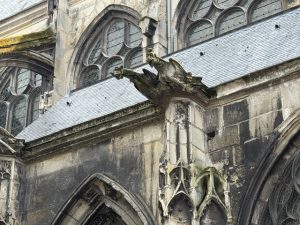
The city of Rouen has endured a turbulent history. It was devastated by fire and plague several times during the Middle Ages and was occupied by the English during the Hundred Years War. Later, it was extensively bombed by the Allies in the second World War. Nonetheless, it still has lots of impressive architecture.
Leave a Reply