Tuesday, June 30, 2026, Day 21 – La Roche-en-Ardennes to Clervaux – 40 miles, 3600’ of elevation gain
Today we crossed from Belgium into Luxembourg, our third country on this trip! Although we changed countries, the riding was similar to France and Belgium—mostly quiet roads with many challenging hills.
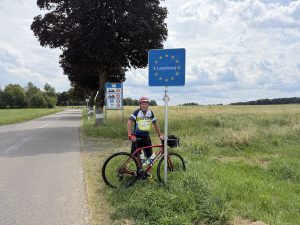
Luxembourg has only 600,000 residents in the whole country. Many of its small hamlets were like others we had seen—a church, a cemetery, and a scattering of houses. A major difference between France and Belgium is the quality of its roads. France and Belgium cover up cracks or imperfections in the roads by putting asphalt patches on top of them, resulting in roads that are often quite bumpy. Luxembourg actually repaves their roads, making them nice and smooth.
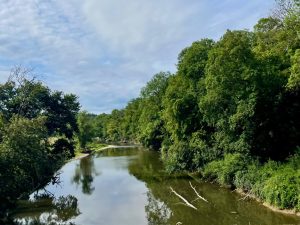
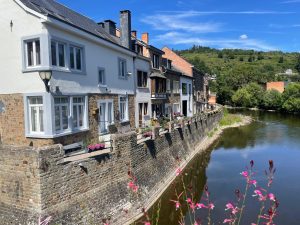
Here are some of our views along the way:
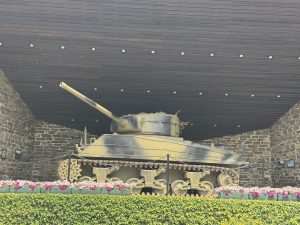
This is still Battle of the Bulge country-the Ardennes region extends from Belgium into Luxembourg. A little history: The Battle of the Bulge was in response to Hitler’s last attempt to conquer armies and land in order to position Germany for more favorable surrender terms because he knew that the Allies would soon overpower Germany’s forces.
The German army aimed to push all the way to Antwerp (a major port in Belgium, not an obscure community in Jefferson County, NY) to cut off and destroy the northern Allied forces in a repeat of the stunning 1940 campaign that had collapsed France in six weeks.
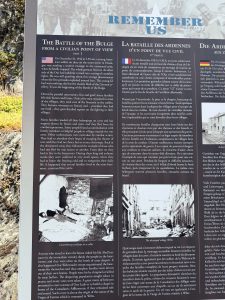
Our tour description for today states, “The assault achieved complete tactical surprise, crashing through thinly held American lines along an 85-mile front, creating a massive westward bulge in the Allied front that gave the battle its name – the crisis reaching its psychological peak at the surrounded town of Bastogne, where the American 101st Airborne Division held a critical road junction against overwhelming German forces, their commander Brigadier General Anthony McAuliffe responding to a German surrender demand with the single word “Nuts” in one of the war’s most celebrated acts of defiant brevity.
The German advance was ultimately broken by a combination of factors. The fanatical American resistance at Bastogne and dozens of other frozen crossroads and villages, the clearing weather in late December that allowed Allied air power to savage German supply columns and armor, Patton’s extraordinary feat of turning his entire Third Army ninety degrees north in seventy-two hours to relieve Bastogne, and the fundamental German inability to capture the Allied fuel dumps they desperately needed to keep their tanks moving. By late January 1945 the Bulge had been eliminated at a cost of roughly 75,000 American casualties and irreplaceable German losses in men and material that fatally accelerated the final collapse of the Third Reich.”
Leave a Reply