Monday, June 29, Day 20, Dinant to La Roche En Ardenne 46 miles, 3400’ of elevation gain.
We started biking today by going through the Village of Dinant which was the home of Adolph Sax who invented the saxophone in the 1840’s. A bridge crossing the Meuse River is lined with saxophones in recognition of him. Immediately after leaving the village, we went up an enormous hill with a 10% grade for about a mile. Very challenging.
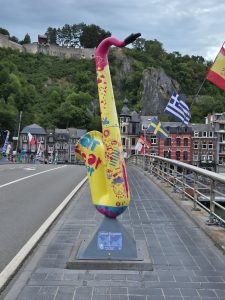
After that, today’s ride through the Ardennes region of Belgium was quite repetitive. Bike up a steep hill then ride down a steep hill. Bike up a long, gradual hill, then coast down a long, gradual hill. Repeat, then repeat.
For about 10 miles, though, we were on a bike path through a wooded area. It was mostly level and a welcome break from the hills:
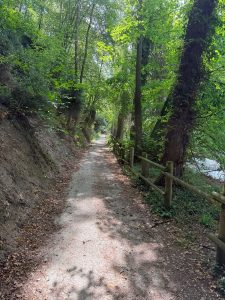
The ride was filled with history because forests and river valleys between Dinant and La Roche-en-Ardenne were the epicenter of the Battle of the Bulge – Hitler’s last great offensive gamble, launched on December 16th, 1944, through the same Ardennes forest that had delivered his greatest triumph in 1940.
Along the way, I passed by a tank in the village of Celles.
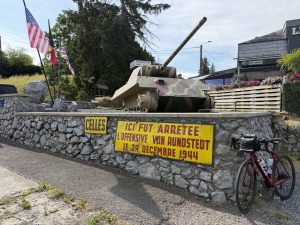
What made it even more interesting was the sign describing it. If you look closely at this plaque, you’ll see that a Belgian woman told German tank commanders that the road to Dinant (that the Germans wanted to take) was lined with mines by the Americans. But she lied because the road was not mined. But the Germans believed here and therefore did not go that way, resulting in the village of Dinant being spared.
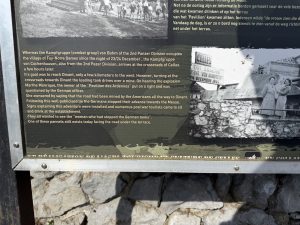
The fighting in hills and valleys of this wooded area was among the most savage and intimate of the entire western campaign. Small American units defending crossroads, villages, and river bridges against German armored columns in temperatures of minus twenty degrees Celsius – weapons jamming, rations frozen solid, men succumbing to frostbite in foxholes scraped from iron-hard ground while artillery shells detonated in the forest canopy above them and rained lethal wooden splinters down instead of reaching the earth and La Roche-en-Ardenne itself was taken by German forces and then heavily bombarded by American artillery fighting to retake it.
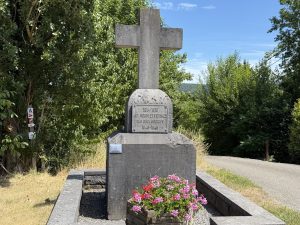
As you might expect, there were many monuments en route, honoring the men and civilians who died in the war.
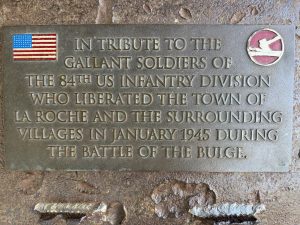
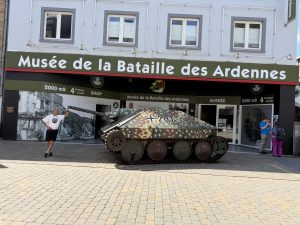
After today’s ride, I went to the village of La Roche-en-Ardenne to go the Museum of the Battle of the Bulge. The man selling tickets there quickly pointed to a picture on the wall of his father who had fought in the Battle of the Bulge.
One of my fellow riders asked him what he thought of Americans. With a churlish look he said, “Some good, some bad.” That is because, during the Battle of the Bulge, La Roche-en-Ardenne was held by the Germans. To get the Germans out of the village, the Americans heavily bombed it. As a result, many civilians were killed and much of the ancient city was destroyed.
In fact, La Roche-en-Ardenne calls itself a martyr city because it took such catastrophic losses in people and property to rid itself of German occupation. Check out this video from the Museum about an American General’s response when the Germans offered him the opportunity to surrender. The first part is in French, but the last part is in clear English.
By late January 1945 the forests between Dinant and La Roche lay littered with the frozen wreckage of tanks and artillery marking the high-water mark of Hitler’s last gamble.
Leave a Reply