Saturday, June 27, Day 18 – Oudenaarde to Mons – 49 miles, 2100 elevation gain
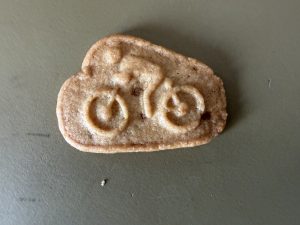
Yesterday, I mentioned that the bicycling culture is quite evident in this area of Belgium. As further evidence of that, after I wrote the blog, I discovered some bicycle shaped biscuits on the counter in my hotel room.
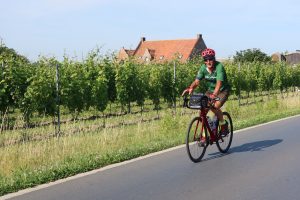
For days, we have been seeing areas rich in agriculture. There are field after field of soybeans, corn, onions, cabbage, lettuce, canola, and often grapevines.
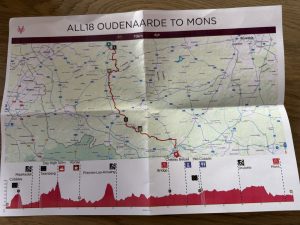
Today’s ride was rigorous for two reasons. First, was the elevation changes. Collectively, 2100 feet is not bad for a 50-mile ride. But, as you can see from this map of today’s ride, we had two nasty hills where the elevation gain was 18-20%.
Secondly, was riding on cobblestones. For some reason, the Belgian road makers are fond of cobblestone at intersections and sometimes just on any ordinary road for no apparent reason. Sometimes the cobblestone streets have a paved section to the right of them so riders can avoid the cobblestones. But that is only true about 10% of the time.
Mons significant in both the Great War and WWII. Interestingly, the British Expeditionary Force fought its first action of WWI at Mons in August 1914, and the war ended with Allied forces re-entering that same city on November 11th 1918 at the moment the guns fell silent, meaning this stretch of Belgian soil witnessed both the opening and closing chapters of Britain’s war.
At Oudenaarde, Belgian and British troops liberated the city in November 1918, after civilians had been living under German occupation for over four years.
At Mons itself, the cruelest irony of the entire war played out on the morning of November 11th, 1918. Despite the Armistice being signed at 5:00 a.m. with the ceasefire timed for 11a.m., commanders on both sides continued ordering attacks and advances during those final six hours, knowing the war was over, knowing the minute and hour it would end, and yet sending men forward into fire regardless. Canadian Private George Price was killed by a German sniper at 10:58am, two minutes before the ceasefire and is recorded as the last Commonwealth soldier killed in the war, shot dead within sight of liberation with the Armistice already signed in a railway carriage in Compiègne forest. The sniper who killed him was never identified.
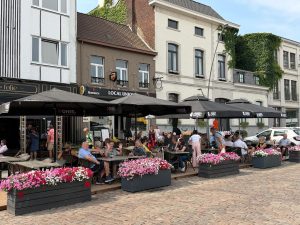
Although we are still in Belgium this region, called Wallonia, is decidedly French. The road signs have switched from Belgian back to French. Today is a Saturday and the Belgian people are living their lives on the weekend. When we stopped in Ronse for our morning break, I saw a couple of examples of that. First was a big market with items for sale ranging from vegetables to shoes.
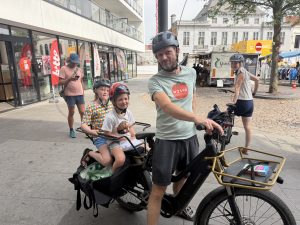
Next, was a young couple with two children who complimented me on my New Zealand bike jersey. I complimented them on their heavy-duty utilitarian bicycle. The man said that, not only can he pull his two daughters, but he can also bring home a week’s worth of groceries with it.
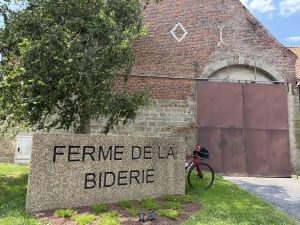
Another simple but memorable part of the day, and an example of ordinary life in Belgium was our lunch stop. Once we left the bustle of Oudenaarde and Ronse, we were in the sparse countryside with huge fields of bountiful crops, quiet roads, and villages mostly characterized by an intersection with a church, a cemetery, and a small grocery store. The area became so sparse, in fact, that we had our lunch under a tree at a handsome farm with four houses near it, the only houses around for miles:
Leave a Reply